The manufacturing sector in Saudi Arabia is changing quickly as the nation strives to meet its goal of achieving Vision 2030 and developing a smart industrial transformation. Industry 4.0 technology is changing the way factories operate through the use of various technologies such as automation, robotics, artificial intelligence, and real-time data systems. Factories in KSA are utilizing smart solutions to increase efficiency, decrease operational costs, and improve the quality of products produced. By executing Industry 4.0 solutions, Saudi manufacturers have a competitive advantage over competitors in today’s growing digital industrial environment.
Manufacturing is becoming more intelligent through the implementation of Industry 4.0 technologies, enabling all manufacturing systems to work smartly. They can also track manufacturing performance on demand instead of responding when an issue arises, and therefore can detect an issue before it occurs. It allows the factory to adjust processes automatically based on performance data. The operation becomes more reliable, productive, and flexible due to increased use of automation, robotics, and data insights. Therefore, manufacturers experience less downtime, higher quality, improved customer satisfaction, and more responsiveness to rapidly changing customer demands.
Transforming Factories in KSA Through Automation, Robotics, and Industry 4.0
Industrial Internet of Things (IIoT)
IIoT provides manufacturers with real-time data analytics from all of their machines, sensors, and equipment on the production floor. By providing this information, manufacturers can receive alerts about machine health, production speed, energy consumption, and quality levels in real-time. Therefore, the use of IIoT allows manufacturers to identify issues quickly, resulting in less downtime, increased productivity, and the ability to make informed data-based decisions. As a result, IIoT is an essential element of smart manufacturing in KSA as well as automation systems.
Artificial Intelligence (AI) & Machine Learning
Big data analytics powered by AI & machine learning is used in manufacturing for pattern recognition and outcome prediction. Smart factories utilize AI to optimize production schedules, detect defects, enhance quality control, and enable intelligent robots to learn how to perform their tasks more effectively through experience. These types of systems evolve as they become more efficient over time, enabling factories to reduce waste, enhance accuracy, and adapt quickly to changing production needs.
Collaborative Robots (Cobots)
Collaborative robots are made to work next to other humans without the protection of cages or barriers. Cobots help with repetitive, awkward, or challenging tasks such as assembly, packing, and checking for quality. This helps to improve productivity and alleviate workers’ fatigue and labour errors. Cobots are versatile and simple to program, making them an excellent option for small and mid-sized manufacturers looking to automate their operations gradually.
Autonomous Mobile Robots (AMR)
Autonomous Mobile Robots move tools, materials, and products within a facility on demand, meaning they are not limited by any fixed or predetermined routes and require no guidance systems. AMRs can be operated using their sensors and artificial intelligence technology, with the ability to generate a mapping of the environment, enabling them to navigate dynamically and avoid obstacles. AMRs also greatly improve internal logistics, reduce the amount of manual handling of materials, and speed up production flows. The primary application of AMRs is in smart warehouses, assembly lines, and large-scale manufacturing operations.
Digital Twins
A digital twin is a virtual version of a physical machine, production line, or factory that uses actual data to reflect the real-time performance of the physical objects. It allows for real-time testing of design changes or prediction of future performance before implementing any real changes to the actual products. Using a digital twin enables manufacturers to reduce risks while optimizing their operations and bringing cost savings through the early identification of potential problems in their operation without halting any onsite production related to those upcoming problems.
Edge Computing
Edge computing is the processing of data close to the source of the machines and equipment, rather than processing all data with a cloud-based solution. This allows for quick decision-making by the factory, with minimal lag time, which is critical in a manufacturing environment where robotics and automation are being used to accomplish manufacturing processes. In addition to improving the overall reliability of the system, edge computing also reduces congestion of the network, along with continuous operations in the event you lose connection to the internet. Therefore, edge computing can be used successfully in a real-time manufacturing environment.
5G Industrial Connectivity
The advancement of 5th Generation (5G) wireless technology provides ultra-high-speed data transfer and low-latency communications between machines, robots, and control systems. In the context of a “smart factory,” 5G technology will allow for communication with robots in real time, connect millions of devices through the internet of things (IoT), and provide high-definition video monitoring. In addition, there will be no need to run heavy, traditional wiring to set up a variety of flexible manufacturing layouts. It improves the level of automation and enables the introduction of emerging technologies such as autonomous robots and augmented reality-type applications.
Augmented Reality (AR) & Virtual Reality (VR)
Augmented Reality (AR) and Virtual Reality (VR) technologies will enhance training, maintenance, and operational efficiencies within a manufacturing environment. AR technology provides technicians with real-time, digital instructions on the actual equipment to help them perform repairs or inspections. VR technology creates a fully immersive learning environment for employee training and robot simulation. These technologies will reduce the number of errors made while performing a task, shorten the time required to learn, and decrease the amount of downtime due to employee accidents or injuries. It increases worker safety when operating in a complex manufacturing operation.
Predictive Maintenance Systems
By utilizing sensors, artificial intelligence (AI), and analytics, predictive maintenance enables manufacturers to predict machine breakdowns prior to them occurring. They can monitor their machines’ performance, as well as the vibrations and temperatures, while continuously monitoring them in order to determine when they need to perform maintenance. This will eliminate unexpected machine breakdowns and extend the life of the machines. It also reduces maintenance costs and provides continuous production without any interruptions.
Cyber-Physical Systems
Cyber-Physical Systems are created by embedding physical machines with a digital control system and using software to control the physical machines. These systems allow robots, machines, and other equipment on the production floor to communicate with one another and coordinate activities. It makes decisions without any human intervention. In addition to enabling machines to optimize themselves, cyber-physical systems also provide real-time adjustments and help automate processes, creating a hyper-connected smart factory environment with all systems integrated. They get the ability to adapt to changes and new manufacturing methods.
Blockchain for Manufacturing & Supply Chains
By utilizing blockchain technology, tracking materials, parts, and manufacturing history is secure, traceable, and cannot be altered. Blockchain improves the visibility of supply chains, improves quality control, and can provide verifiable records to ensure the traceability of parts and materials in manufacturing processes. Using blockchain to maintain a shared and verifiable record of the data creates trust between suppliers and manufacturers. It also bridges between manufacturers and end-users, while also preventing fraud and assuring compliance.
Quantum Computing (Early Adoption)
With its still-nascent state, quantum computing possesses tremendous promise to address complex manufacturing difficulties. Quantum computers can handle very large amounts of information and enable the optimization of production schedules, logistics, and material utilization in a manner that has not previously been possible with conventional computing solutions. Quantum computing could forever change how factories are planned, as well as AI modeling and how we optimize at all times in complex industrial systems in the future.
AI-Enhanced Additive Manufacturing (Smart 3D Printing)
Additive manufacturing using artificial intelligence, unlike conventional methods, optimizes design, materials, and production parameters. It automatically results in faster prototypes, custom parts, and lightweight components with high accuracy. Smart 3D printing assists flexible manufacturing, minimizes material waste, and provides the ability for manufacturing facilities to produce very complex parts that would have been impossible to do using traditional technologies.
Tulip Technologies Robotics Solutions Powering Smart Factories in KSA
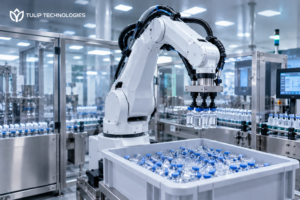
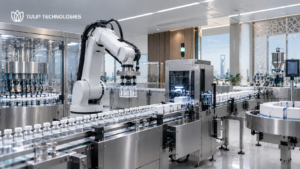
Tulip Technologies delivers advanced industrial robotics solutions designed to improve efficiency, precision, and safety in Saudi factories. From automated assembly lines to material handling and packaging robots, their solutions help manufacturers reduce manual workload and increase production speed. By integrating robotics with existing systems, Tulip Technologies enables factories in KSA to achieve higher output, consistent quality, and scalable automation aligned with Vision 2030 goals.
Industry Vision AI for Intelligent Quality Control
Tulip Technologies provides Industry Vision AI solutions that help factories detect defects, monitor processes, and ensure product consistency in real time. Using AI-powered cameras and smart analytics, manufacturers can identify quality issues early and reduce waste. These vision systems improve inspection accuracy, lower rework costs, and support data-driven decision-making across production lines in the competitive manufacturing sector.
Robotics Solutions Powering Smart Factories in KSA
Tulip Technologies delivers advanced industrial robotics solutions designed to improve efficiency, precision, and safety in Saudi factories. From automated assembly lines to material handling and packaging robots, their solutions help manufacturers reduce manual workload and increase production speed. By integrating robotics with existing systems, we enable factories in KSA to achieve higher output, consistent quality, and scalable automation aligned with Vision 2030 goals.
Industry Vision AI for Intelligent Quality Control
Tulip Technologies provides Industry Vision AI solutions that help factories in Saudi Arabia detect defects, monitor processes, and ensure product consistency in real time. Using AI-powered cameras and smart analytics, manufacturers can identify quality issues early and reduce waste. These vision systems improve inspection accuracy and lower rework costs. It supports data-driven decision-making across production lines in KSA competitive manufacturing sector.
End-to-End Smart Automation Solutions for KSA Factories
Tulip Technologies offers complete smart automation solutions, combining robotics, vision AI, and system integration. Our team supports factories from consultation and design to deployment and ongoing optimization. By delivering tailored Industry 4.0 solutions, we help Saudi manufacturers modernize operations, enhance productivity, and build future-ready factories that meet local regulations and global manufacturing standards.
Frequently asked question
What industries in KSA can benefit from Tulip Technologies’ robotics solutions?
Tulip Technologies supports manufacturing, logistics, food & beverage, automotive, and industrial sectors in Saudi Arabia.
How does Vision AI improve factory quality control?
Vision AI detects defects in real time, reduces human error, and ensures consistent product quality.
Can Tulip Technologies integrate solutions with existing factory systems?
Yes, all solutions are designed to integrate smoothly with existing machines and production lines.
Are Tulip Technologies’ solutions aligned with Saudi Vision 2030?
Yes, the solutions support automation, digital transformation, and smart manufacturing goals under Vision 2030.