Smart Factories have changed the manufacturing landscape through the usage of advanced technology to maximise accuracy and production capabilities. The machine vision system is one of the most significant technologies that is revolutionizing and redefining modern-day manufacturing processes in KSA. These Automated Visual Inspection and Analysis systems act as the “eyes” of today’s production lines by providing the producers and manufacturers with intelligent cameras, sensors, and artificial intelligence (AI). It facilitates improved product quality control, operations optimization, real-time digital decision-making, etc.
Machine Vision Systems utilize a combination of integrated hardware and software to collect and utilize visual information from a company’s manufacturing processes. Typical components include;
- ultra-high-resolution cameras
- advanced high-technology lighting
- image processing machines
- artificial intelligence (AI) algorithms
These are utilized to automatically calculate image analysis results to allow for defect detection, dimensional measurements, assembly verification, and also provide guidance for robotic operations. Machine vision technology provides consistent and objective visual analyses of items at greater speeds than humans can. It is a required part of any production environment in Saudi Arabia that has to be operated in a fully automated way.
How Machine Vision Supports Smart Factories
By utilizing networked and data-driven technologies in their production systems to automate workflows and enhance production outcomes, smart factories leverage machine vision. It provides real-time visual information about the manufacturing state directly from the shop floor. The ability of machine vision systems to validate a manufactured product’s quality and help reduce the amount of manual work required to produce that product, to easily connect to robots, programmable logic controllers, and industrial IoT platforms.
Enhanced Quality Control and Defect Detection
Unmatched Accuracy in Inspection
The ability of machine vision systems to accurately identify minimal manufacturing defects is a key feature of the technology. While humans may not see these flaws, a machine vision system is specifically programmed to search for, find, and flag problems such as cracks, misalignments, and irregular shapes. Machine vision systems constantly check product quality throughout the entire manufacturing process. This allows manufacturers to catch defects earlier in the production process and greatly reduce the cost of rework.
Consistency in Evaluating Product Quality
Each individual doing quality checks using visual inspection methods differs from those doing the same task with machine vision. As each individual performs the task, they may also become fatigued, and the result of each inspection may be affected by fatigue or the individual’s subjective judgment. Machine vision systems perform the same inspections on thousands of parts consistently, accurately, and without error – meaning they will produce uniformity in inspection and result in very high-quality products.
Boosting Productivity and Throughput
High-Speed Image Processing
Production line speeds are enabled by machine vision systems. They take and process images on the production line quickly enough so that inspection does not become an impediment to high throughput or the ability to consistently check product quality.
24/7 Operation Without Fatigue
Unlike human inspectors, who require rest periods, machine vision systems do not require rest periods, do not experience fatigue, and do not become less productive over time. This means machine vision systems allow greater uptime, increased production levels, and less reliance on staff for inspection during shifts.
Cost Reduction and Waste Minimization
Early Detection Reduces Waste
Early identification of defects within the production process will stop defective goods from being manufactured, ultimately reducing product waste and rework costs associated with these defects. Machine vision systems also allow manufacturers to make proper adjustments before manufacturing to reduce errors and maximize their manufacturing output.
Reduced Labor and Inspection Cost
Automating visual checks provides manufacturers with a reduced workforce cost, as well as being able to move their manufacturing personnel to higher-value jobs, such as supervising and optimizing the production system. This change provides manufacturers with improved operational efficiencies and lower long-term costs.
Integration with Robotics and Automation
Vision-Guided Robotics
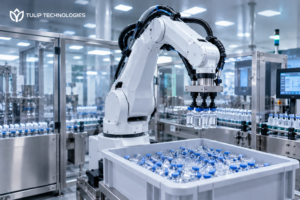
Using Machine Vision Systems, Robotic Arms, and Automated Guided Vehicles (AGVs) can perform complex tasks with accuracy due to the ability to detect the location, orientation, and visual markers of parts on the assembly line. Machine vision technology allows for accurate pick and place operations or handling of delicate components with minimal error.
Connection to Control Systems
Today, Machine Vision technology provides seamless integration with PLCs, SCADA systems, and various industrial network protocols such as Ethernet/IP and PROFINET. The integrated capabilities create synchronized movement between visual inspections and automated machinery, resulting in a fully integrated manufacturing environment.
Data-Driven Decision Making
Real-Time Insights
Machine Vision provides manufacturers with large amounts of data that allow them to analyse their products and processes for quality and trends. This helps improve product manufacturing by making better decisions and eliminating inefficiencies while optimising work parameters as they occur.
Predictive Maintenance and Trend Analysis
Machine Vision with AI also provides predictive maintenance to monitor equipment condition as well as predict future maintenance needs, allowing for the prevention of breakdowns and reducing downtime, therefore extending machinery lifespan.
Improved Worker Safety
Monitoring Hazardous Zones
Machine vision can monitor restricted areas or ensure compliance with safety protocols such as verifying that workers wear protective equipment. These systems help reduce workplace accidents and ensure safer production environments.
Automated Alerts and Safety Controls
When unsafe conditions are detected, vision systems can automatically trigger alarms or halt production, protecting workers and machinery from harm. It acts like a predictive maintenance strategy to avoid breakdowns.
Future of Manufacturing with Machine Vision
As manufacturing evolves toward Industry 5.0 and beyond, machine vision systems will become more intelligent with deeper integration of AI, deep learning, and cloud-based analytics. These advancements will further improve the adaptability, scalability, and autonomous decision-making capabilities of factories in Saudi Arabia. Tulip Technologies is driving smarter, greener, and more competitive industrial operations in KSA with robotic solutions, AI, and automation.
The Competitive Edge of Machine Vision
Machine vision is no longer a luxury it’s a necessity for factories seeking competitive advantage in the Saudi market. By ensuring precise inspection, driving automation, and enabling real-time insights, these systems elevate smart manufacturing to new levels of performance, quality, and innovation. Forward-thinking manufacturers who implement machine vision gain improved operational control, reduced operational costs, and a stronger foundation for future growth.
Industrial Vision Systems for Smart Manufacturing in KSA
Looking to transform your factory into a smart, data-driven powerhouse? Tulip Technologies delivers advanced AI & Industrial Vision solutions that empower manufacturers to improve quality, boost efficiency, and automate visual inspection across production lines. From defect detection to predictive quality and real-time process optimization, Tulip’s tailored vision systems give your factory the competitive edge it deserves. Discover smarter manufacturing today with Tulip Technologies the future of industrial vision.
Frequently Asked Questions
What industries benefit most from machine vision systems?
Machine vision is widely used in automotive, electronics, pharmaceuticals, food & beverage, and consumer goods industries. It is used due to its precision in inspection, assembly verification, traceability, and automation needs.
How does machine vision improve product quality?
By consistently analyzing visual data at high speeds, machine vision systems detect defects and anomalies early in the process. It ensures only quality products advance while minimizing errors and waste.
Can machine vision work with AI and robotics?
Yes. When combined with AI and robotics, machine vision enhances autonomous operations like robot guidance, adaptive sorting, and dynamic workflows.
Is machine vision expensive to implement?
Initial costs vary based on complexity, but long-term benefits include cost savings, reduced waste, and higher production efficiency. They deliver a rapid return on investment (ROI) for smart factories.