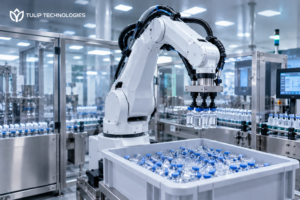
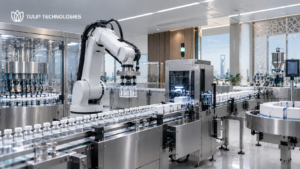
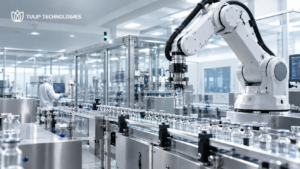
Industry 4.0 is reshaping manufacturing with smart factories that handle automation, data, and connectivity. Modern production relies on automation to boost performance, reduce errors, and bring consistent quality. AI-based industrial vision solutions are now at the forefront, enabling machines to see, analyze, and respond in real time. By leveraging these technologies, factories can monitor operations, detect issues instantly, and optimize processes. Tulip Technologies is helping industries transform their operations through AI vision, making production smarter, faster, and more reliable.
The industrial vision systems are modern technologies that let machines observe, check, and analyze objects in the manufacturing processes. Conventional vision systems are based on set rules and pattern recognition, which do things, such as detector defects or measure with expected accuracy. By contrast, AI vision systems employ machine learning and deep learning to adapt, learn data and take complex or changing situations into consideration with greater accuracy.
These smart systems enhance performance and minimize errors, and facilitate decisions made in real time. When combined with cameras and sensors, industrial vision systems become an essential part of the automation and quality control of the present day.
Key Components of AI-Based Industrial Systems
Cameras and Sensors
The central part of the AI vision systems comprises cameras and sensors. They absorb visual data of the surroundings, including not only simple images but also detailed 3D data. The cameras that are of high quality with specific sensors will be able to detect, measure, and analyze the results accurately. This will be the basis of sound AI-based decision-making and automated work.
Lighting Systems
Lighting systems play an essential role whereby images are regularly and transparently. Adequate light mitigates the shadow, glare, and reflections, which means that visual data can be deciphered by the AI system. Lighting enables the identification of objects, quality inspection, and tracking. It is environmentally adaptable and hence vision systems are dependable under a wide range of industrial, commercial, or outdoor situations.
Image Processing Software
Image processing software performs the analysis and interpretation of information that has been obtained by cameras. It brings out clarity, patterns and derives meaningful insights. Object detection, item classification and movement tracking in real time are achieved with algorithms. The program can convert raw pictures into valuable data and allow artificial intelligence to automate its functions, increase precision, and enhance operational efficiency.
Edge Computing Devices
Edge computing computers handle information at the place of capture. This minimizes latency, enables real-time decision-making and minimizes dependency on cloud infrastructure. Processing computation on-site increases performance, reliability, and security, and thus, AI vision systems are faster, more responsive and can be used in critical applications in manufacturing, robotics, and autonomous technologies.
Emerging Role of AI in Industrial Vision Sector
The industrial vision industry is changing as Artificial Intelligence allows machines to perceive, interpret and react to their surroundings with unprecedented accuracy. The application of AI-based vision systems has become very common in quality control, predictive maintenance, as well as real-time monitoring of production lines. These solutions are helpful in helping manufacturers to identify errors, minimize waste and maximize operations quicker than the traditional ways.
Industries can be more accurate and efficient by incorporating machine learning algorithms with advanced cameras and sensors. Additionally, industrial vision AIs enable safer working environments as possible hazards are detected at an early stage. The uptake of AI-based vision systems is likely to increase rapidly in manufacturing industries due to the improved technology.
Significant Benefits of AI-Based Industrial Vision Solutions
Excellent Quality Control
The vision systems developed by AI check the quality of products with accuracy, which guarantees uniformity. With the early identification of defects or irregularities, manufacturers can save waste, minimize rework and produce high-quality products for customers. This helps in increasing brand trust and working efficiency across lines of production.
Better Operational Performance
Industrial AI vision enhances the pace of production by giving real-time information. It assists in recognizing the bottlenecks, tracking the performance of machines, and streamlining the workflows. This enables the factories to achieve more output with less, using minimal resources and reducing the costs without compromising the level of productivity.
Predictive Maintenance
AI vision technology is an automated system that keeps checking the state of equipment. It is able to predict future failures before they occur by detecting early wear or malfunctions. This will reduce unexpected downtimes, maintenance expenses, and disruptions, as well as provide a smooth and continuous production flow.
Bettering Workplace Safety
Vision systems with AI are used to detect safety hazards. They are capable of sensing human presence close to hazardous equipment, checking adherence to safety measures and sending an alarm to the personnel immediately. This makes the workplace a safer place to work and minimizes the risks of accidents in factories.
Improved Evidence-Based Decision Making
Industrial vision systems gather and process large amounts of visual information. AI processes this data to give an actionable response. It then allows managers to make well-informed decisions, streamline processes, and become strategic in terms of efficiency, innovation, and sustainable growth in manufacturing practices.
Integration of Real-Time Factory Automation with AI Vision
The application of modern technologies to oversee and manage production in real time is called real-time factory automation. With the implementation of AI vision systems through machines and robots, factories can be more precise and efficient. AI vision allows inspecting assembly lines automatically, picking and placing robots, and sorting and packaging accurately.
Such systems minimize mistakes, accelerate the production process and enhance the throughput. As an example, AI vision is applied in the automotive assembly lines to control the robots to place the components in accurate locations and guarantee quality and uniformity. This technology revolutionizes the world of manufacturing, making processes smarter, faster and more reliable.
Challenges of AI Vision in Real-Time Factory and Solutions
High Initial Investment
The implementation of AI vision will have high initial expenses in the form of cameras, sensors, computing hardware and software. Small or mid-sized factories may not justify such expenses. The first option is modular systems, and phased deployment can help minimize the initial financial load. It enables companies to grow gradually as the first gains can be achieved in quality control and efficiency.
Complexity In Legacy System Integration
The factories usually use outdated machinery and PLCs that are not compatible with AI connections. Implementing AI vision in these environments may be technologically challenging. Collaborating with vendors, middleware, and modular and flexible solutions supports the efficient interoperability with minimal downtime and the exchange of data between AI systems and the current infrastructure.
Data Privacy and Cybersecurity Issues
The AI vision systems are sensitive in gathering production information, and this information can be hacked by cyber threats. The existence of secure data storage, encrypted communication, and adherence to privacy rules play a crucial role. Hybrid cloud-edge systems also enable sensitive data to be processed at the edge. This will be minimizing the exposure and still take advantage of cloud capabilities to implement analytics and update models.
Need for Sufficient Data to Train AI Models
High-quality datasets that are diverse are needed to achieve AI vision accuracy, but they may be scarce. Lack of sufficient data causes misclassification or overlooking defects. The annotation of data, synthetic data, and augmentation methods assists in the practical training of strong models. This enables the AI system to be able to identify variations in products, defects, and environmental conditions to ensure that it is reliable.
Future Trends in AI-Based Industrial Vision Beyond 2025
The trends of AI-based industrial vision in the future are promising to bring revolutions in manufacturing efficiency and flexibility. Predictive analytics will streamline the work of the factory, foreseeing the maintenance requirements and factory bottlenecks. The combination of AI vision and IoT will allow building intelligent factories. Thus, machines will be able to communicate harmoniously to know more about monitoring and control.
AR applications will enable the interaction between humans and machines. This will take the form of real-time feedback and instruction in complex activities. AI vision systems with self-learning capabilities will change among new products and production lines with minimal human input. These technologies, combined with 5G and fast connectivity, will enable real-time automation and agile and data-driven production.
Conclusion
AI-based vision is revolutionizing real-time factory automation, helping manufacturers improve productivity, maintain high quality, and reduce costs. By adopting these smart solutions, businesses can stay competitive in a fast-changing market. Tulip Technologies supports industries in embracing AI vision, paving the way for smarter operations and a more efficient future in industrial automation.
Frequently asked questions
How does it improve factory automation?
It provides real-time defect detection, object recognition, robotic guidance and operational costs while increasing production speed and quality.
What industries use AI vision systems?
Manufacturing, automotive, electronics, food processing, pharmaceuticals, and logistics industries use AI vision for quality control.
What are the main benefits of AI vision?
Key benefits include better quality control, increased performance, improved safety, and cost savings by reducing errors and waste.
What challenges exist in implementing AI vision?
Challenges include high initial costs, integration with legacy systems, data management, and training AI models with modular solutions and cloud-edge technologies.