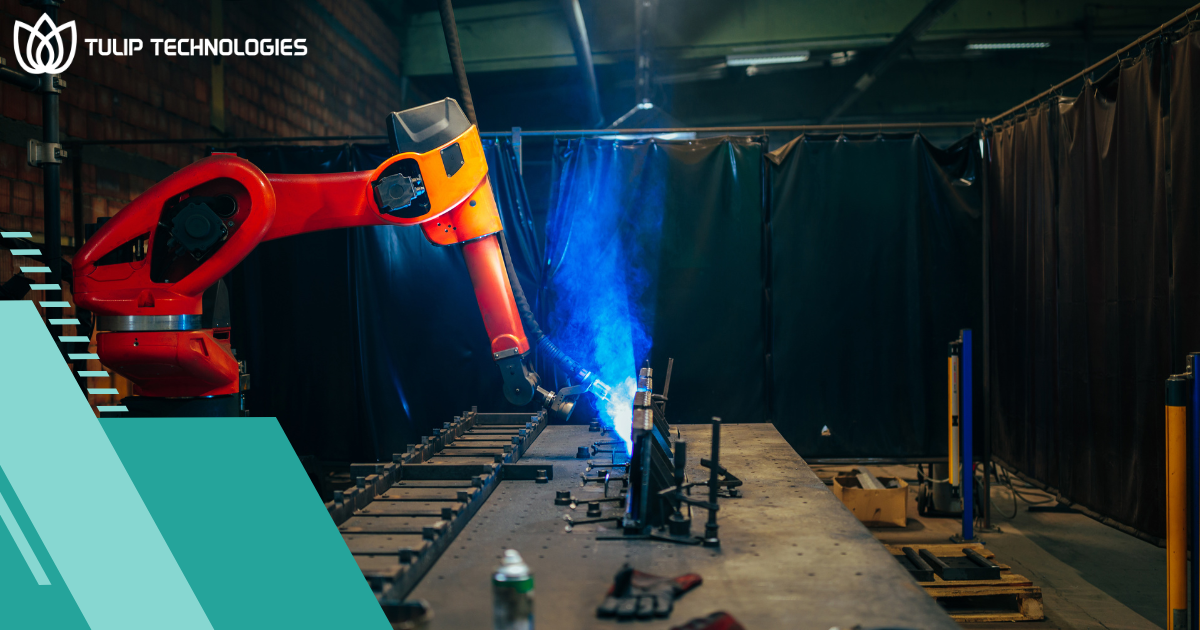
MENA is transforming its industrial sector under Vision 2030 with rapid growth in advanced manufacturing. Demand for automation is rising in fabrication, automotive, oil and gas, and heavy industries. Robotic welding is becoming essential for modern production. Manufacturers are shifting from manual welding to automated systems. Tulip Technologies provides robotic welding and Industry 4.0 solutions in MENA. Today. This guide explains how robotic welding systems improve speed and precision in a sector.
Despite the advancement and modernization of technology, there are still many industries in MENA that are using manual welding systems. Although it comes with numerous advantages, it still poses some challenges that need to be addressed. Finding skilled employees is becoming increasingly difficult, and wages are on the rise annually. Manual work relies on human effort and working hours, and that can lead to quality variations as well.
Welding can show dangerous results due to the use of heat, sparks, and heavy machinery. In MENA, industries are seeking better, faster, and more reliable welding systems solutions to enhance the productivity of manufacturing. The change will be significant for big construction, oil, and manufacturing projects all over the country. It also helps to satisfy contemporary industrial needs effectively and securely.
Different Ways Robotic Welding Improves Precision and Speed
Consistent Weld Quality
A robotic welding systems will always yield the same outcome, over and over. Their operation is entirely faultless and operates on predetermined paths to minimize defects and enhance quality in industries. This also guarantees equal keenness of the weld between the items and increases safety, reliability, and adherence to the standards requirements achieved.
Faster Production Speed
Robots don’t tire or fatigue, which boosts productivity in factories/Workshops. They can weld several pieces at the same time, which humans cannot do. Automated systems also cut the time lost waiting for each task, which enables industries to achieve their deadlines and boost production much more efficiently.
Reduced Human Error
When manual welding, there will be a lot of little errors. Robots execute precise commands and perform them with accuracy. This decreases the rework and material waste in production. Sensors are used to detect errors in the welding process. Hence, this enhances overall efficiency as well as cuts down expenses in industries that guarantee product reliability each time.
Improved Workplace Safety
High heat and sparks are created during the welding systems operation. Robots take the place of humans in hazardous situations, which helps to reduce the incidence of injury and accidents. Distance control is possible for the operation of machines. Safety systems also halt machines in the event of issues, making work environments more secure as a whole.
Lower Operational Costs
Robotic welding eliminates the need for large labor teams. It also reduces errors, leading to costly rework. The machines run all day and don’t require additional compensation, which increases productivity and minimizes downtime in production lines. Savings are predictable and manageable overall maintenance costs.
The Role of Industry 4.0 in Robotic Welding
Industry 4.0 is transforming the process of welding in modern industries. It links up machines, data, and smart systems to create a more efficient and controlled system. Manufacturers in MENA are making use of automation to improve their manufacturing quality. Real-time data of welding processed through a sensor and software helps to gather data. This information can be used to enhance and optimize performance in the long term, and also to minimize errors in the company.
It also facilitates better planning, predictive maintenance, and quicker decisions. In sum, Industry 4.0 enables smarter welding systems in order to boost productivity. Making it more competitive for industries to produce high-quality products for the world markets. This change holds fundamental importance for the future development of industry and innovation in the sector as a whole.
Key Features to Look for in a Robotic Welding Systems
Precision Control System
To operate robotic welding systems successfully, there is an immediate need to implement strict control features. This way of doing it guarantees the proper welding of all joints and surfaces. In advanced programming, it is possible to repeat an action without making any errors. It also supports the guarantee of uniformity of production, which is a crucial feature in an industrial manufacturing process.
High Welding Speed
High-speed welding systems increases production efficiency. Robots can perform welding tasks more quickly than manual welders. which cuts down the production time substantially in factories. The faster welding also helps in meeting the tight deadlines. It facilitates industries to expand their production and profit with smooth and high productivity operations along all production stages.
Sensor Based Accuracy
Sensors are a major component in robotic welding. They check the quality of welds, alignment, and heat, which assists in real corrections of errors. It enhances the consistency of the weld and decreases the occurrence of defects in the weld. Advanced sensors deliver fine feedback to operators for quality control at every touch on the process.
Easy Maintenance Design
A modern welding systems is designed for easy maintenance, which means there will be less downtime for repairs and servicing. Quick component replacement and inspection are needed to ensure factory ‘Around-the-clock’ running. Regular maintenance contributes to overall efficiency, which improves with fewer machine breakdowns and unexpected production delays.
Flexible Welding Applications
There are numerous applications that can be performed with robotic welding systems. They work on a variety of materials, such as steel and aluminum. The flexibility is applicable to various industrial requirements. Systems can be programmed to create complex welding shapes. This enhances production versatility and efficiency, thus adapting them for modern production all over the world.
Real-Time Monitoring Systems
Real-time monitoring makes it easier to monitor and improve welding quality. In the welding process, the operators can look at the data. This will provide for easy changes on the fly if necessary. It minimizes errors and boosts production accuracy in industries. Safety and operational efficiency are greatly enhanced by monitoring systems, and operators are constantly fed on their performance.
Future of Robotic Welding in MENA
The prospects of robotics welding systems in MENA are quite positive. The number of industries that will use automation is going to increase in the years to come. This will boost productivity and enhance manufacturing quality in different industries. Hence, this system is getting huge support from the government for industrial development. Robotic welding will save a lot on cost and enhance workplace safety.
It will also generate new skilled employment opportunities in the field of advanced manufacturing. Systems will be more intelligent and efficient with the advancement of technology. This change will help to sustain the industrial competitiveness of the region over the long term. More investment will be made in the automated welding solutions and innovation in the manufacturing and energy industries.
Conclusion
In conclusion, manual welding in manufacturing often faces challenges in precision, speed, safety, efficiency, and scalability. Robotic welding systems solve these issues by delivering consistent results and improving productivity. Tulip Technologies helps manufacturers adopt robotic welding for long-term competitiveness today, now effectively.
Frequently Asked Questions
Which industries in MENA use robotic welding?
Industries such as automotive, oil & gas, metal fabrication, construction equipment, and heavy manufacturing widely use robotic welding systems.
Are robotic welding systems cost-effective?
Yes. Although the initial investment may be high, robotic welding reduces labor costs, material waste, downtime, and rework over time.
Can robotic welding systems integrate with existing production lines?
Modern robotic welding systems are designed for easy integration with conveyors, CNC machines, and smart factory environments.