Saudi Arabia is experiencing rapid industrial growth driven by technological advancement, closely aligned with the goals of Vision 2030. As manufacturers strive to improve efficiency and competitiveness, automation has become a key focus area. Robotic palletizing plays a vital role in this transformation. Traditional palletizing methods often face challenges such as labour shortages, high operational costs, safety risks, and inconsistent output. Tulip Technologies is helping industries transition toward robotic solutions, enabling smarter, safer, and more efficient manufacturing operations.
Introduction of Robotic Palletizing
Robotic palletizing is a process that involves the use of robots to place and stack products on pallets to either be stored or transported. This technology substitutes human labour, enhancing the efficiency, speed and uniformity of industrial procedures. It is widely used in manufacturing, warehousing, and logistics industries where large volumes of goods need to be handled quickly and accurately.
Robotic palletizing systems can perform product sorting and sorting of different types, sizes and weights of products. These systems reduce human involvement, which decreases the number of errors, reduces labour expenses, and improves safety in the workplace. Robotic palletizing is an important part of contemporary supply chain management as industries are increasingly automating.
Important Components of Robotic Palletizing to Know
Robotic Arm and End Effector
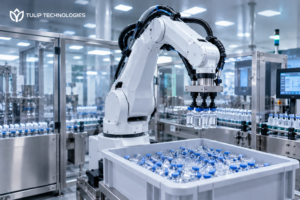
The main part that facilitates the movement and positioning of the products in the palletizing process is the robotic arm. It operates an end effector, or a tool that is connected to the arm and used to hold objects. End effectors consist of vacuum grippers, clamps, or special tools, depending on the application, to ensure a product is securely handled and placed.
Conveyor System
The conveyor system moves the products off production or packaging lines to the palletizing area. It provides a continuous and structured movement of goods that the robot should deal with. The conveyor has sensors that locate the presence and position of the products. This helps to ensure that the robotic arm coordinates with the sensors to ensure smooth and efficient operations without interruptions.
Control System and Software
The control system and software serve as the brain of robotic palletizing. They are the ones who program and control the movements of the robot, the way it stacks and its pace. The high-tech software enables the customization of the various pallet configurations and types of products. It can also be integrated with other systems to track performance, identify mistakes, and streamline overall efficiency in real time.
Sensors and Vision Systems
The sensors and vision systems assist the robot to detect, find and examine products before stacking. Such systems guarantee the proper positioning and orientation of goods on pallets. Vision technology involves cameras and image processing to identify orientation, size and defects and enhances accuracy and minimizes mistakes in the palletizing process and increases overall reliability.
Safety Systems
In robotic palletizing workplaces, safety systems are required to protect workers and machinery. These will consist of light curtains, safety fences, emergency stop buttons, and motion sensors. They make sure that the robot is only working in safe case. Hence, it stops as soon as a person gets into the working area, eliminating accidents and ensuring the safety rules are observed.
Increased Productivity
Robotic palletizing is much more productive as it does not get tired and works at a higher pace. Robots do not need to take breaks like human workers and can work 24/7, processing large volumes of products at the same speed. This increases the rate of output and efficiency in production processes and enables the companies to respond to demand better.
Greater Accuracy and Consistency
Robots deliver accurate and uniform palletizing as they do not deviate from the course. This minimizes human error, such as wrong stacking or damage to the product. Uninterrupted placement also guarantees enhanced stability of the loads. This matters in the safe transportation and storage, which ultimately enhances the quality and reliability of the operations.
Reduced Labor Costs
Automating the process of palletizing will enable companies to save on the costs of having to use manual labor, which will result in cost savings. Despite the high initial cost, robotic systems can save money in the long run as decreased wages, training and overtime costs would result in savings in the manufacturing facility.
Enhanced Workplace Safety
Robotic palletizing saves the workers from physically demanding and repetitive work. This reduces the chances of strains, sprains and accidents that may occur due to heavy lifting. This leads to a safer working environment, and companies can adhere to occupational health and safety standards better.
Flexibility and Adaptability
The contemporary robotic palletizing system is very flexible, and it can be reprogrammed to fit various products, pallet configurations and production specifications. This flexibility enables the manufacturers to respond swiftly to product line or packaging changes, making operations more flexible and responsive to market needs.
Common Industries in Saudi Arabia Using Robotic Palletizing
Robotic palletizing is a common practice in various industries in Saudi Arabia to improve efficiency and address the increasing industrial needs. It is used in the food and beverage industry to manage packaged foods and hygienic practices. Palletizing systems are used in the oil and gas industry to organize equipment and materials. The pharmaceutical sector enjoys the advantage of accurate and contamination-free manipulation of medicines.
Also, robotic palletizing finds application in the logistics and warehousing industry to simplify the storage and distribution procedures. These systems are also used in the construction industry to manage building materials. As Saudi Arabia is dedicated to automation and developing industries, robotic palletizing is still growing in different industries.
Challenges of Implementing Robotic Palletizing
Despite its benefits, there are challenges associated with implementing robotic palletizing. The initial cost of investment is high, and this may be a challenge for small and medium-sized companies. The need to integrate with existing systems might demand technical knowledge and changes in the existing workflows.
Moreover, the maintenance and repair require skilled technicians who can incur operational expenses. It may also require time and resources to train employees to operate with robotic systems. Workers might be resistant to change because they worry about job security. Moreover, the productivity may be impacted by system downtime caused by technical problems. To effectively counter these challenges, careful planning and proper implementation are required.
Drive Growth in Saudi Manufacturing with Tulip Technologies
In conclusion, robotic palletizing offers significant advantages, including improved efficiency, enhanced safety, reduced operational costs, and greater scalability for manufacturers. As Saudi Arabia continues to expand its industrial sector, automation has become a strategic necessity rather than an option. Solutions provided by companies like Tulip Technologies support this transformation, helping businesses stay competitive, productive, and aligned with future growth demands.
Frequently Asked Questions
Why should Saudi manufacturers invest in robotic palletizing?
It improves efficiency, reduces costs, enhances safety, and supports the goals of industrial growth under Vision 2030.
Is robotic palletizing suitable for small businesses?
Yes, modern systems are scalable and can be customized to fit small and medium-sized operations.
How does robotic palletizing improve safety?
It reduces the need for manual lifting and minimizes workplace injuries caused by repetitive or heavy tasks.
What industries benefit most from robotic palletizing?
Industries like food & beverage, construction, pharmaceuticals, petrochemicals, and logistics benefit significantly.