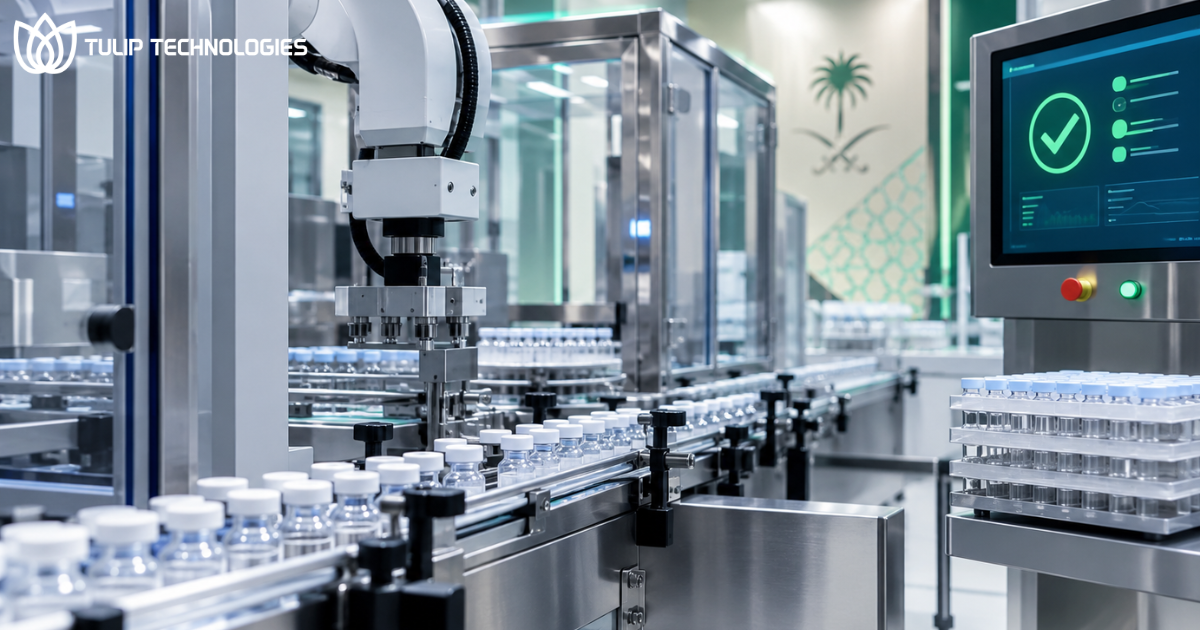
Manufacturers under the regulation of the Saudi Food and Drug Authority (SFDA) must meet rigorous Good Manufacturing Practice (GMP) standards during every step of the manufacturing process, and documenting compliance through manual checks and written logs has proven cumbersome. A single missing signature or a missed report on a deviation could easily result in a costly recall or unfavorable regulatory action. Therefore, it is not surprising that more and more manufacturers in Saudi Arabia have started to implement automation. In this blog, we will review exactly how automation can help eliminate risks in the production process and improve SFDA and GMP compliance in factories. KSA Production units need SFDA GMP compliance automation system.
SFDA compliance relies on internationally accepted GMP standards. Manufacturers are required to prepare all documents and reports regarding every step of the process, including the handling of raw materials. It also includes inspection of equipment, production of the batch, and releasing the final product. All records should be accurate, and discrepancies should be controlled throughout the process. SFDA GMP compliance automation system helps these standards to be consistent.
The Hidden Risks of Manual GMP Processes
Physical files and spreadsheets might appear easy to handle day-to-day, but often become ineffective as soon as the audit comes up. Manual data entry leads to typing errors, absence of signatures, and non-standard formats across shifts. Deviations tend to be reported with a delay as operators carry in their minds the information needed for filling the reports. Even minor omissions create problems in terms of compliance. Actually, data integrity problems are often cited as a main reason for warning letters issued by regulators, which transforms manual systems from a safe option to an ever-growing liability.
How Automation Can Help in Reducing Compliance Risks
Automated systems collect data right after the event takes place, removing the gap between doing and documenting the action. In this way, electronic batch records get filled automatically while an operator is executing a certain stage, and manual data entry is replaced with minimized error problems. Moreover, if any necessity for a certain check is missed, the system is able to stop operation.
Real-Time Deviation Management and Alerts
One of the key benefits of automation is the ability to detect deviations instantly. With sensors in place, it is possible to mark an off-spec condition as the anomaly happens. This allows the team to fix a minor problem before it turns into a disaster. In other words, instead of seeing the temperature being out of specification only in the weekly review. The quality team is aware of it at the exact point in time and can act on it immediately. This means that the record will have a timestamp and will be generated automatically by the system which is much more acceptable for SFDA inspection than paper logs issued after reconstruction.
Digital Batch Records and Data Integrity
Digital batch records solve one of the most critical problems in GMP compliance related to data integrity and managing it. Automated solutions use audit trails, electronic signatures, and version control that meet ALCOA+ principles, which is vital for the process. These features help to comply with all SOPs and standard regulations to maintain quality work. It helps to solve issues. It stores all data for checking and inspection.
Standardizing Operator Training and SOP Adherence
Errors made by humans are still among the most common reasons for GMP violations and are usually the result of poor training or using outdated processes. Through the use of automated tools, detailed electronic instruction can be incorporated into regular work activities, reminding workers of each step taken and confirming if an action is successful before a new task is completed. This guarantees that everybody will always have access to the latest version of the SOP and protects against the drift of old paper instructions on the floor of the facility. As an added benefit, it can also help with decreasing the differences in the work done by operators during shifts.
Equipment Monitoring and Preventive Maintenance
Unintentional failure of machinery often causes GMP violations and production losses. The use of condition monitoring helps monitor the functioning of machinery on a constant basis and detect the first signs of machine wear before it harms the quality of the output. This helps plan preventive maintenance rather than react to emergencies and saves the time of putting the equipment out of commission. However, that is not all. The program keeps automatic records of maintenance and calibration processes, so that you can comply with the documentation policy of the SFDA without a need for additional paperwork.
Faster, More Confident Regulatory Audits
When all production info is stored in one cohesive system, audit preparation is much quicker and less stressful. Quality teams can access innovative batch data as well as past deviation and training logs much faster. The ability to connect and analyze data translates into the fact that SFDA inspectors notice that the quality system has matured. Automation helps to decrease the possibilities of non-compliance during the audit while still proving the fact that production processes are now under full control.
Scaling Compliance Across Multiple Sites
When it comes to compliance, multi-site manufacturing is also a complex process. Companies often use manual systems, and together with different operating procedures, each facility develops its own approach to compliance. This makes it difficult to maintain quality at different plants. A unified automation system can help manufacturers maintain the same level of compliance and get rid of practices that vary from plant to plant.
Choosing the Right Automation Approach
Not every automation platform delivers the same value for compliance. The best systems are flexible enough to fit your existing GMP workflows without forcing a complete process overhaul, while still enforcing the controls regulators expect to see. Look for platforms that support electronic batch records, real-time analytics, configurable quality checks, and simple integration with your current equipment and ERP systems. The goal is not automation for its own sake. It is building a connected system where compliance becomes a natural part of daily work.
Turning Compliance Into a Competitive Advantage
Facilities that treat GMP compliance as a checkbox often deal with repeated deviations and slow, stressful audits. Those that build compliance into their daily operations gain a real advantage, including fewer batch failures, faster releases, and stronger relationships with regulators. Automation shifts quality from a final inspection step to something built into the process from the start. For SFDA-regulated manufacturers, this is not just about avoiding warning letters. It is about creating a production environment that can grow with confidence in a tightly regulated market.
Ready to Reduce Production Risk with Tulip
Tulip’s automation solutions in Saudi Arabia for frontline operations help SFDA-regulated manufacturers digitize batch records, enforce SOPs in real time, and capture deviation data the moment it happens. It is deployed without replacing your existing equipment or systems. If your team is still relying on paper or spreadsheets to manage GMP compliance, now is a good time to see what a connected, no-code platform can do for your production floor. Book a demo with Tulip today and start turning compliance into a real, everyday advantage.
Frequently Asked Questions
What is the difference between SFDA compliance and general GMP compliance?
SFDA compliance refers to meeting the specific requirements of the Saudi Food and Drug Authority, which are built on globally recognized GMP principles. While GMP provides the general quality framework, SFDA adds region-specific rules around registration, documentation, and inspections for companies operating in Saudi Arabia.
Can automation fully replace manual quality checks in GMP environments?
Not entirely. Automation reduces manual data entry, errors, and delayed reporting. Automation makes sure the underlying data is accurate and available the moment it is needed for human review.
How long does it typically take to implement a compliance automation platform?
The timeline depends on the size and complexity of your facility. No-code automation solutions by Tulip can roll out digital work instructions or batch records within a few weeks, while a full rollout across multiple lines or sites is done in phases to avoid disrupting production.
Will automation systems work with our existing equipment and ERP software?
Modern automation systems are built to integrate with your current setup rather than replace it. Tulip automation system integrates with existing PLCs, sensors, and ERP systems, pulling everything into one unified dashboard.
What SFDA actually requires?
SFDA compliance relies on internationally accepted GMP standards.It also includes inspection of equipment, production of the batch, and releasing the final product. Production units need SFDA GMP compliance automation system.