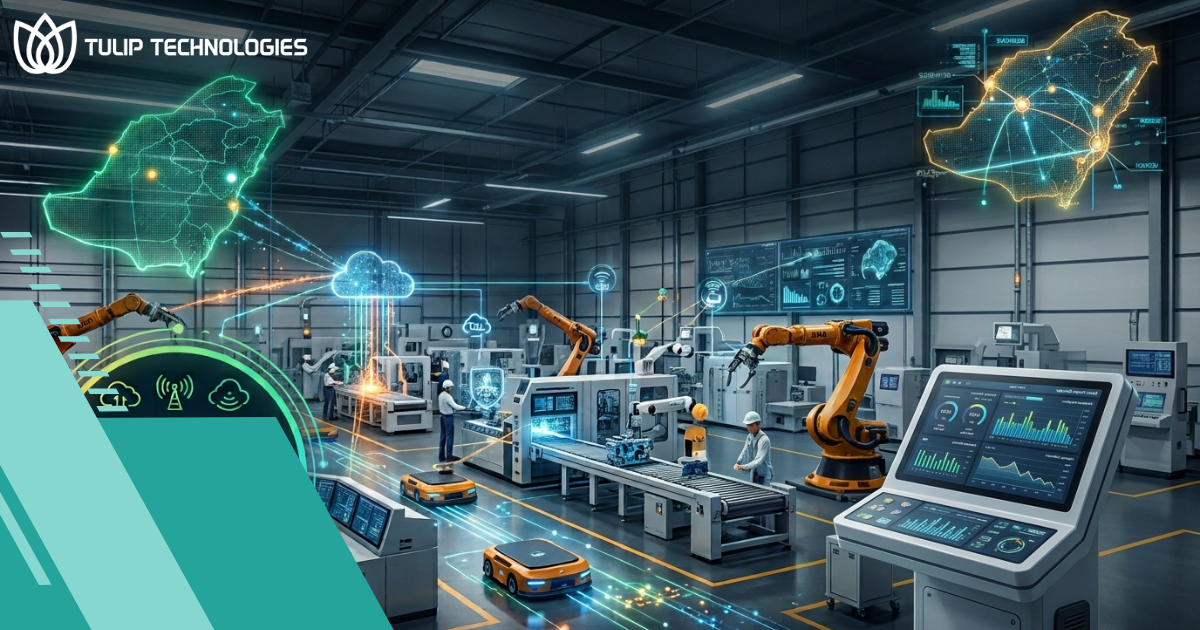
Industrial production standards provide guidance to manufacturers in Saudi Arabia on how to improve productivity and production quality with smart management and technologies. It integrates advanced smart solutions like automation, artificial intelligence, IoT, and cloud computing to create connected factories. It is helping industrial growth in Saudi Arabia. Leading manufacturers running production units in Saudi Arabia are investing in digital transformation to stay competitive in the LOCAL market. They have adopted smart manufacturing solutions to increase productivity.
We are guiding you to make your industries align with the Saudi 2030 Vision, which can lead them to growth with advanced technologies and automation. We will increase understanding of what Industry 4.0 is, its core pillars, and why following it is important. These standards can not only save you time but also improve efficiency in the upcoming modern, automated industrial era in KSA, preparing you for what comes next and preventing your industry from being left behind.
- Industry 4.0, the next generation of manufacturing, enables a smart generational automation system. To keep your production business competitive, knowing about it helps you move forward in this modern technological era that demands a clear path with automation, professionalism, time-saving, lower costs, and efficiency.
- The Fourth Industrial Revolution, or Industry 4.0, is a vision of the future. The digital transformation of industrial automation combines data analysis, systematic automation, and connecting machines, software, and devices so they can communicate with each other in real time. This gives the industry a real-time decision-making automated system with greater speed and accuracy, which prevents delays in problem-solving and is less costly for monitoring production and optimizing performance.
- Traditionally, manufacturing requires physical monitoring to prevent risks or delays in problem-solving. Compared to a 4IR manufacturing system, it solves defects in a timely manner or waits until they are cleared. Generally, raising our industries without manual processes is not possible. Having both manual and digital systems balances tasks and lets the employers take a break from the repetition of tasks. A set of examples of Generation 4.0 digital twins, smart warehouses, robotics, AI, IoT, and additive manufacturing.
Why Follow Industry 4.0 in Saudi Factories?
Following 4.0 keeps your manufacturing business in Saudi Arabia in the competitive league with high expectations of work, efficiency, cost-effectiveness, and mass customization. Adapting industry standards for your business not only standardizes your business, but it also changes it to predictive control. Industry 4.0 lets us know a machine is damaged before it is visible to a human eye, having trouble managing, transferring data, or missing inventories, wrong orders, or delays in shipping; IoT can handle it flawlessly without any complications. Changing features takes time due to many things; automated systems take it under control. Inaugurating a generation for your industry provides the ability to be a more competitive industry.
Core Pillars of Industry 4.0
There are nine core pillars of Industry 4.0, which are divided into 3 main categories. It helps the industry grow in various ways.
Connectivity & Network Infrastructure
The first main category of Industry 4.0 pillars is considered the backbone of an industry. It focuses on the interconnection of systems and linking devices to work in real-time. The Industrial Internet of Things (IIoT) connects machines and sensors to the internet, sharing data simultaneously. Cloud computing provides storage and space to process the data. Horizontal and vertical system integration helps to build a chain in the industry, connecting management to the factory floor, which runs business seamlessly across the entire business. Cybersecurity defends the industry from digital attacks and threats, protects sensitive data, and ensures the system runs smoothly.
Intelligence & Insight (Data Processing)
The second main category of Industry 4.0 pillars is considered the brain of an industry. Big data and analysis are the technological systems that help in analyzing large amounts of data and making the process efficient. Simulation (digital twins) is the process of making a test manufacturing machine to examine if the machine is able to work in the main factory.
Physical Execution & Interaction
The final main category of Industry 4.0 pillars, different from the first two, is this category where humans and machines can interact with each other. With Augmented Reality (AR), employees can check the reporting through AR glasses to survey the instructions or audit the rules/instructions guided to the machine or humans. Additive manufacturing (3D printing) is the process of making digital three-dimensional designs layer by layer, preventing flaws in the final result. “Autonomous robots” refers to technological robots that help in industries with complex tasks that require human help or not. They work safely and prevent safety risks for human workers.
How Factories Can Get an Industry 4.0 Assessment in Saudi Arabia
Getting an Industry 4.0 assessment is a simple process when you work with an experienced automation partner like Tulip. The assessment helps identify improvement opportunities and creates a practical roadmap for digital transformation.
Schedule an Initial Consultation
Share your production goals, current processes, and business challenges with the experts.
Complete a Factory Assessment
Specialists visit your facility to evaluate equipment, workflows, automation level, and data systems.
Identify Improvement Opportunities
The team finds areas where automation, smart sensors, and digital tools can improve productivity and reduce downtime.
Receive a Digital Transformation Roadmap
You get a clear plan with recommended technologies, expected benefits, priorities, and implementation stages.
Start Implementation with Tulip
Tulip helps deploy the recommended Industry 4.0 solutions, integrates them with your existing operations, and provides ongoing support to ensure long term success.
Call Tulip for Industry 4.0 standards Assessment in Saudi Arabia
Tulip Technologies is a leading company providing smart factory automation solutions in Saudi Arabia. We help manufacturers in Saudi Arabia adopt Industry 4.0 standards with practical automation solutions. We offer complete factory assessment services and check these standards. We also suggest a better smart phase to optimize your factory production operations. If you want to start building a smarter production base and check these standards for Industry 4.0, then contact Tulip today. We offer the best industrial AI vision solutions and reliable factory SIRI assessment services in Saudi Arabia.
Frequently Asked Questions
What is an Industry 4.0 assessment?
It is an evaluation of your factory to identify digital transformation and automation opportunities.
Why do Saudi manufacturers need Industry 4.0?
It helps improve efficiency, reduce costs, increase productivity, and stay competitive.
How long does an Industry 4.0 assessment take?
The timeline depends on the size and complexity of your manufacturing facility.
Can Tulip help implement Industry 4.0 solutions?
Yes. Tulip provides assessments, automation solutions, system integration, and ongoing support for manufacturers in Saudi Arabia.