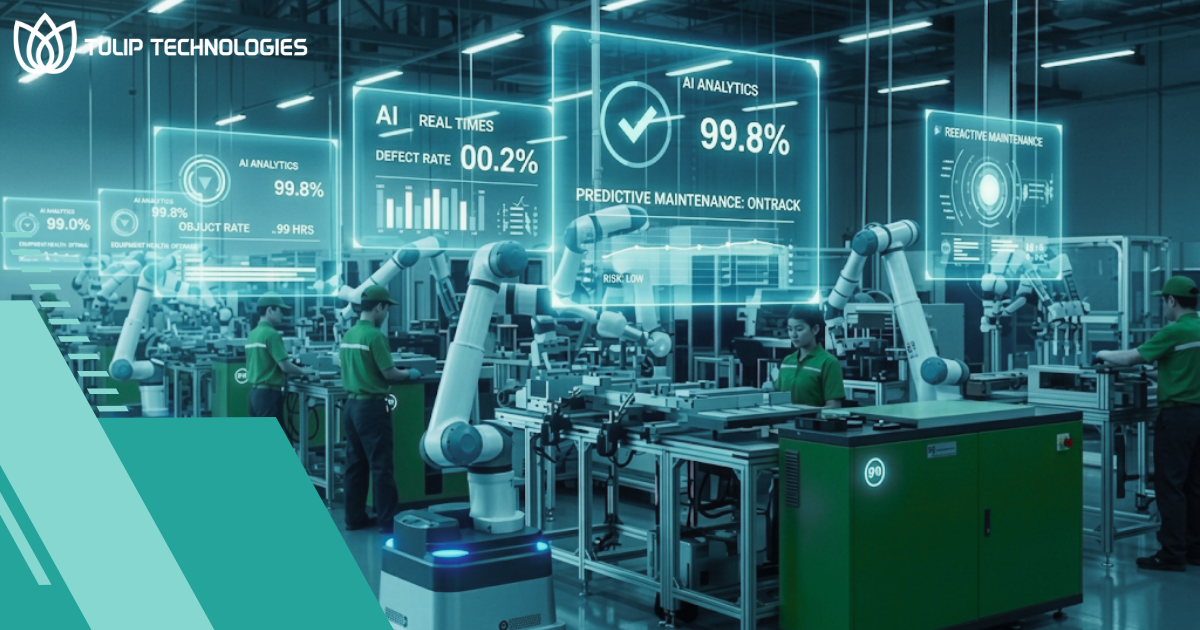
Just a broken part passes through the production line without anyone noticing it until it is too late. An exhausted inspector fails to detect a minute defect. A piece of equipment malfunctions with no prior warning. All such small errors can accumulate quickly in terms of cost. A decent amount of expense occurs in the form of recalls, approvals, and loss of time while not being productive. Now we can speak about machines. Machines do not become tired. Machines do not miss anything because they cannot sleep or cease paying attention to work.
Artificial intelligence is improving the functioning of the company’s production process in many different aspects. It makes it possible to detect defects the moment they occur. It gives instructions to robots precisely so that there is no need to check where a problem is coming from. It identifies machine problems beforehand so that a breakage does not happen. There will be a number of cases discussed here. The main aim of this blog is to show what artificial intelligence vision technologies can do for the manufacturing industry in Saudi Arabia.
Artificial Intelligence machine vision refers to technology that facilitates the recognition of images and handling of visual information by machines like humans do with their eyes and brain. Cameras and sensors are used to capture images of products and activities in the factory. AI then processes that information automatically in order to generate information. It provides information on incoming materials, on production of products, and on labeling and packing. It also delivers information about how much of the products are in the warehouse. In contrast to human inspectors, machine vision systems don’t get tired or lose concentration, and their decisions are always the same.
How AI Machine Vision Works
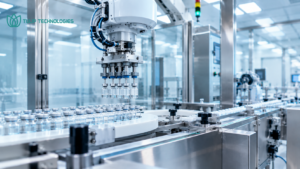
The process of machine vision in artificial intelligence is short but efficient. In the beginning, the camera records the image of a component or a product in the assembly line. Precise lighting is required for the image to be bright and clear because a blurred photo may conceal non-conformities and create false defects. At the next stage, the picture goes to AI software for analysis that has learned over the years with the help of numerous examples of images and knows at least the basic features of the good product and the defective one. The software analyzes the new image, searching for patterns, shapes, colors, and sizes it has already memorized. At the end of the analysis, the software makes a decision in no time. Thus, finishing the cycle with the help of quality inspection AI.
Use Cases for AI Machine Vision in Manufacturing Industry in KSA
Defect Detection and Quality Inspection
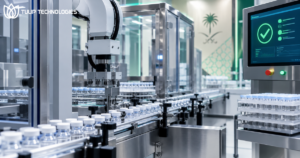
Manufacturing units operating in Saudi Arabia, particularly in its auto parts, petrochemical, and food processing industries, require consistent quality to operate globally. AI machine vision detects scratches, cracks, dents, and other surface problems while goods undergo production. Devices are capable of taking images of every item produced, and artificial intelligence software is able to compare these images with the learned patterns. This robotized process is more efficient than the work of a human quality inspector. Using this technology, plants make sure to comply with various international standards, including initiatives like Saudi Vision 2030.
Dimensional Measurement and Verification
Multiple manufacturing sectors in Saudi Arabia, namely construction materials, metal fabrication, and machinery parts, depend on precise measurements in order to satisfy safety and performance specifications. To this end, quality inspection AI can ensure that the parts are manufactured according to the required tolerances irrespective of whether measurements are taken with manual gauges or calipers. In this process, cameras take pictures, and the AI software instantly carries out the required measurement of the products according to the specifications given. As a result, human errors are eliminated, quality checks are sped up, and the manufacturers can comply with rigorous export standards.
Assembly Verification
Saudi factories dealing with electronics, appliances, and machinery must confirm that all the parts are in the correct position to make sure that further processing can go ahead smoothly. To this end, industrial vision systems & machine vision AI can confirm whether all the screws are tightened, the connectors are positioned correctly, and the decals are put on the product correctly. This way, defective items can be identified and eliminated from the assembly line. That in turn is going to save a lot on recalls in the industries undergoing the transformation in Saudi Arabia.
Barcode, QR Code and Label Reading
Traceability matters greatly for Saudi manufacturers exporting goods internationally. Artificial intelligence machine vision reads and verifies codes and text on packaging, even when labels are damaged, angled, or low contrast. Using optical character recognition, it ensures accurate tracking across the supply chain, helping companies meet compliance requirements and maintain trust with global trading partners.
Robotic Guidance and Pick and Place
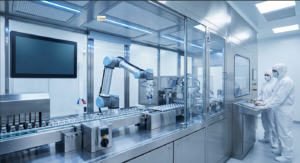
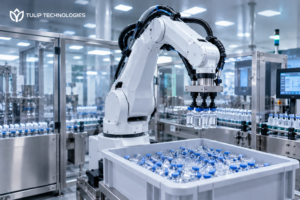
As Saudi factories automate more processes, robotic arms need accurate visual guidance to work efficiently. Artificial intelligence machine vision helps robots locate, orient, and grasp parts correctly on a conveyor or in a bin, even when items are randomly oriented. This bin picking capability boosts automation speed and supports Saudi Arabia’s push toward smart, technology driven manufacturing facilities. Machine vision manufacturing is the smart way to boost productivity.
Predictive Maintenance via Visual Monitoring
Manufacturers in Saudi factories often have to bear the cost of equipment failure. Quality inspection AI is the best feature for analyzing the camera fields of machinery, identifying defect issues, and finding any problems early before they occur. The issues can be a sign of wear, leaks, corrosion, or misalignments. It works as a predictive maintenance factor that allows the teams to act before a breakdown happens. This way, you can save on equipment costs and reduce costly, unplanned downtime.
Counting and Inventory Tracking
AI features help manage accurate inventory to handle a large volume of goods. It automatically counts different goods and items like cans, bottles, boxes, or any kind of everyday item on a production line or in storage. This way, you get accuracy in inventory management in a short time and smartly. Moreover, at all times, you get visibility into your stock level, which helps you maintain good supply chain planning.
Color and Surface Consistency Checks
The sensors also help to consistently identify patterns, designs, and colors, like automotive, paint, and textile operations in Saudi Arabia, which need these features most. AI smart tools ensure the same color, texture, and finishing on each product. The cameras detect even very slight changes and variations that human eyes might miss. This way, manufacturers can maintain high quality control and maintain brand quality standards with consistent finishing every time.
Worker Safety and PPE Compliance Monitoring
Smart factory automation and the use of AI machine vision help you maintain a safe and sound workspace environment for employees and workers in factories. The features also help to detect whether workers wear required safety gear or equipment to follow PPE compliance. It also flags unsafe behavior, such as unauthorized entry into sensitive zones near machinery. This way, these features help to maintain more safety and to avoid accidents in workspaces while complying with safety regulations.
Sorting and Classification
Manufacturing procedures have different phases, like food processing, recycling, and electronics manufacturing, mostly depending on fast and detailed sorting. Artificial intelligence automation sorts things and products accurately according to size, shape, color, or grade. This way, the sorting and classification process is done faster. Hence, factory owners can easily handle large volumes smartly with consistent product quality standards. Quality inspection AI manages it all.
Benefits of Deploying AI Machine Vision in Manufacturing
Smart AI machine vision in factories in Saudi Arabia gives many benefits to the factory owners and manufacturers. You can get higher accuracy and consistency in quality production. They can control quality standards and security standards. You can easily reduce labor lost by the automation process and save enough material costs. Better traceability fully complies with Saudi regulatory standards and reduces downtime.
You can easily maintain a safe and sound workspace for workers to produce fewer workplace accidents overall. The data-driven insights help you monitor production quality all the time with better visibility. AI vision also has scalability features for quick deployment in multiple lines. So to succeed in the production industry, you should adopt smart technologies and advanced AI machine vision automation in your factories in Saudi Arabia.
Ready to Bring AI Machine Vision to Your Factory Floor?
Tulip Technologies offers the best AI machine vision automation solutions to manufacturers in Saudi Arabia. We offer robotic solutions and smart factory automation solutions with real results. We intelligently connect your people, machines, and data on one integrated system. You must use a smart setup by industrial vision systems that manages automation and AI assistance. Get in touch with Tulip Technologies today to implement AI machine vision on your factory floor in Saudi Arabia.
Frequently Asked Questions
What is artificial intelligence machine vision in manufacturing?
Technology that lets machines see and inspect products using cameras and artificial intelligence by industrial vision systems.
How does machine vision improve product quality?
It catches defects instantly and consistently, without fatigue or human error.
Is AI machine vision expensive to implement in factories?
Costs vary, but most manufacturers see savings quickly through less waste and rework with machine vision manufacturing.
Can machine vision work with existing factory equipment?
Yes, machine vision manufacturing easily integrates with most existing production lines and machinery.