Saudi Arabia’s food and beverage industry is growing quickly due to rising population, urban lifestyles, and demand for safe, high-quality food. Under Vision 2030, the country is focusing on modern and efficient industrial practices. Automation is playing a key role in this shift. Solutions offered by companies like Tulip Technologies help factories improve productivity, maintain consistent quality, reduce costs, and meet strict food safety standards through advanced technologies. This guide explores the importance of automation solutions for food & beverage factories in Saudi Arabia.
The food and beverage industry in Saudi Arabia is expanding rapidly because of a rising population, increasing incomes, and changing lifestyles. There is an increased consumption of food outside of the home and fast food, particularly in major cities. The sector is also receiving support from the government as part of its Vision 2030 to diversify the economy beyond oil.
Fast foods, cafes, and healthy foods are in high demand. Moreover, tourism and religious tourists boost food consumption all year round. Production locally is also growing, yet the nation continues to import most of the food products. In general, the business has numerous possibilities for investors, businesses, and new entrepreneurs.
Importance of Automation Solutions for Food & Beverage Factories
Automation systems play a significant role in food and beverage factories since they can enhance efficiency, quality and safety. Robots can operate more quickly and precisely than humans without errors and wastage. There is also the consistency in the quality of products that is guaranteed by automation, and this is significant in customer satisfaction. It supports the factories to achieve high production levels at reduced operational costs in the long run.
Furthermore, automated systems enhance hygiene as they reduce human interactions with food items. This is particularly significant in keeping food safety standards. At the end of the day, automation enables factories to be competitive, be more productive, and provide improved products reliably and at a reasonable price.
Modern Automation Technologies in Food & Beverage Factories
Robotics in Production
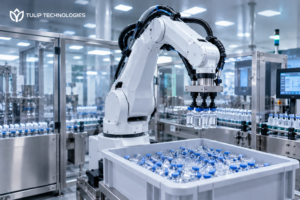
Food factories have been reducing human labor by using robots to perform activities such as picking, packing, and sorting. They are fast and accurate, cutting down the human input. Robots also enhance safety by doing repetitive or dangerous chores. They are flexible, and therefore the factories can deal with various products effectively and produce products of a constant quality.
Internet of Things (IoT)
IoT is a type of technology that links machines and devices via the internet. It enables monitoring of the production processes, temperature, and equipment performance in real-time. This helps the factory managers to identify issues early and make prompt decisions. IoT enhances performance, lessens downtime, and leads to enhanced management of the entire manufacturing process.
Artificial Intelligence (AI)
AI helps the manufacturing industries to process data and make intelligent choices. It can forecast failures in equipment, streamline production schedules and enhance the quality of products. The AI systems process historical information to enhance functionality over time. This saves on wastage, enhances efficiency and assists the factories to react promptly to market demands.
Automated Packaging Systems
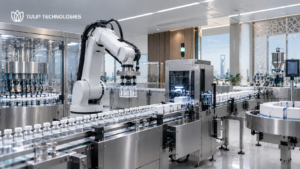
Products are filled, sealed and labeled by automated packaging machines that can fill, seal, and label products fast and with precision. They reduce manual labour and speed up the pace of production. These systems maintain that the systems are sealed and labeled properly to enhance the brand and safety of the product. It is also applicable to automate packaging to minimize errors and ensure consistency in high volumes of production.
Process Control Systems
Process control systems oversee and manage various production steps. They also make sure the level of temperature, pressure and mixing is up to standard. This assists in the creation of quality products each time. Such systems are also less prone to human error and enhance efficiency, which makes production more trustworthy and manageable.
Applications of Automation in Food & Beverage Factories
Food and beverage factories are also applying automation in most parts to enhance operations. It helps in the processing of raw materials, in which machines can transport and measure the ingredients precisely. In processing, refrigeration, mixing and cooking are automated to control the quality. Packaging and labeling are also automated to enhance speed and minimize errors.
Quality inspection is automated, and sensors and cameras measure the standards of the products. It also aids inventory management by real-time monitoring of stock levels. Also, there are automated cleaning systems which are hygienic and safe. Altogether, automation enhances efficiency, and product quality is maintained at the same level throughout the entire production process.
Regulatory and Compliance Considerations in Saudi Arabia
The factories in Saudi Arabia that deal with food and beverages must be subjected to stringent policies to maintain the quality and safety of the products. The government agencies, such as the Saudi Food and Drug Authority (SFDA), guide hygiene, labeling and production standards. Automation helps the factories to achieve these needs by ensuring that the processes and records are maintained consistently.
Systems can track production data and are helpful in audits and inspections. Factories should also comply with the halal certification regulations, whereby the products of the factory should comply with the Islamic dietary laws. Proper documentation and traceability are important for compliance. It is possible through automated systems to reduce human error in factories, keep standards and make sure that all regulations are followed appropriately.
Future Trends in Food & Beverage Automation Beyond 2026
Food and beverage factories will have increased automation and intelligence in the future. The use of technologies such as AI and machine learning will further enhance efficiency and decision-making. Connected systems will be used in smart factories to monitor and control activities. Robotics will be made more versatile and capable of performing complicated tasks.
Sustainability will also be addressed, and with automation, will assist in minimizing the consumption of energy and waste. High-tech data analytics will enable improved forecasting and planning. Factories can also consider more customized production to satisfy the wishes of customers. On the whole, automation will keep revolutionizing the industry to make it more efficient, safe and innovative.
Add Your Heading Text HEmbracing Automation Solutions for a Smarter Future ere
Automation is now essential for food and beverage factories in Saudi Arabia to stay competitive and efficient. By adopting modern solutions from providers like Tulip Technologies, businesses can improve quality, meet regulations, and build a strong, sustainable future in a rapidly changing market.
Frequently Asked Questions
Why is automation important for Saudi F&B factories?
It improves efficiency, ensures food safety compliance, reduces costs, and supports Vision 2030 goals.
What technologies are commonly used in F&B automation?
Robotics, IoT, AI, PLC systems, and automated packaging technologies are widely used in Saudi F&B factories.
Is automation expensive for small factories?
Initial costs can be high, but phased implementation and long-term savings make it viable.
How does automation improve food safety?
It reduces human contact, ensures consistent processes, and enables real-time quality monitoring.