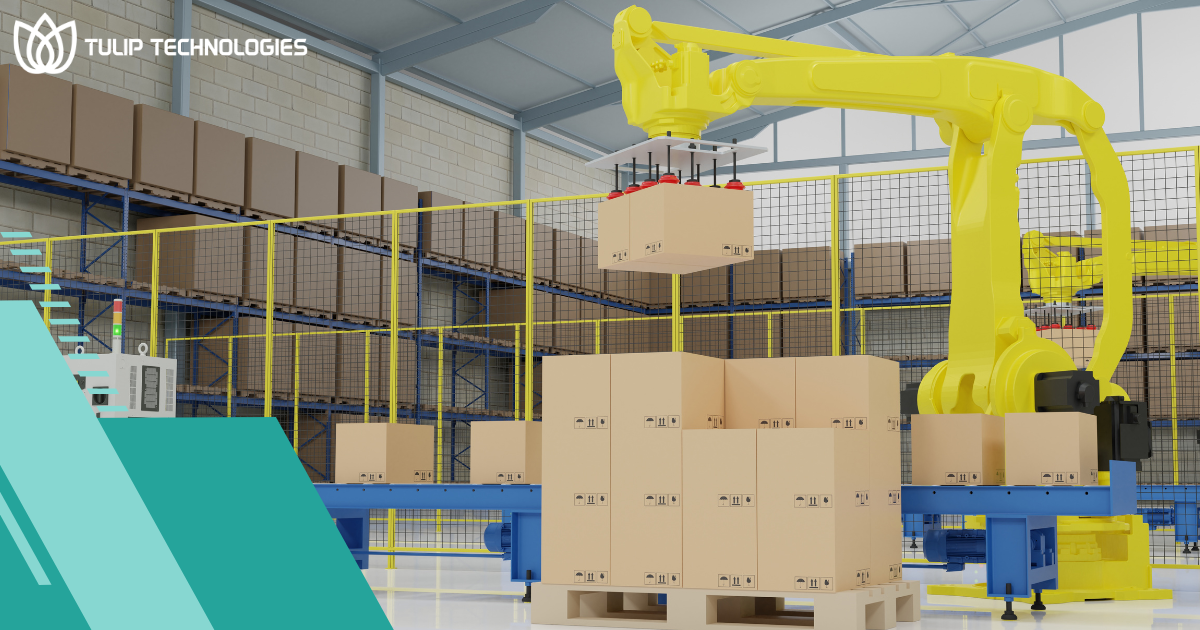
Manufacturing plants and automate packaging today face many challenges, including rising labor costs, faster production demands, workplace safety risks, and the need for consistent product quality. To stay competitive, factories are now investing in end-of-line automation solutions such as automate packaging automation and palletizing systems. These technologies help reduce manual work, improve speed, minimize errors, and create safer working environments. Tulip Technologies is helping factories modernize operations with MENA-built robotic solutions, designed to improve efficiency, productivity, and operational reliability.
Robotic Pick and Place Systems
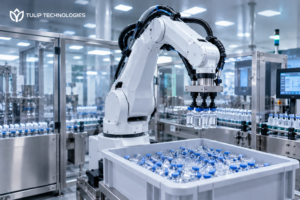
Robotic pick and place systems are used to quickly and accurately move products in the manufacturing process. Such robots retrieve products from a conveyor and place them in a box or container. They decrease manual work, speed up production, and minimize product damage potential in the packaging and palletizing processes every day.
Conveyor Belt Automation
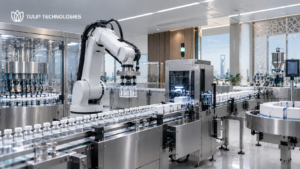
Products are transported smoothly between different stages of the production process by automated conveyors. They contribute to reducing delays and manual handling within manufacturing plants. Conveyor systems are used to enhance the workflow, ensure product consistency, and facilitate quicker pack and palletize operations.
Automatic Stretch Wrapping Machines
Automatic Stretch Wrapping Machines wrap pallets in plastic film before shipping goods. These machines enhance the safety of the product while it is being transported and stored. They save time, minimize material handling waste, and give equal pressure for wrapping to all pallets for better load stability and protection during delivery operations.
Vision-Guided Packaging Systems
Camera and sensor systems determine product and automate packaging positioning (vision-guided systems). They assist machines in the correct product placement in cartons or pallets. As a result of these systems, more accurate package printing is achieved, automate packaging errors are minimized, and manufacturers can work with various product sizes and shapes without significant production interruptions or delays.
Collaborative Robots for Packaging
Cobots, or collaborative robots, are used in automate packaging plants alongside human workers. They can help to lift, sort, and palletize without the use of large safety barriers. By enhancing productivity, minimizing physical strain on employees, and enabling manufacturers to automate packaging processes without sacrificing flexibility in their production workflows, cobots are a notable advantage.
Key Components of an Automate Packaging and Palletizing System
Robotic Arms and Grippers
Robotic arms and grippers are key components of the automated packaging process. They move, carry, and position products with high accuracy. Various grippers provide secure handling of boxes, bags, bottles, or containers. These parts boost speed, lessen human labor, and contribute to uninterrupted manufacturing processes throughout the day in the dynamic production setting.
Conveyor and Transfer Systems
In the automate packaging and palletizing stages, transportation and transfer systems transport products between machines. They reduce the delays in production flow due to manual transport and keep it at a steady pace. These systems increase efficiency, accelerate processing, and provide more structure and uniformity in a manufacturing process, especially when handling high volumes of product.
Sensors and Vision Technology
Automate packaging systems are equipped with sensors and vision technology to locate, measure, and track products. Cameras assist machines in positioning items accurately in automate packaging and palletizing operations. These technologies minimize mistakes, enhance quality control, and assist manufacturers to ensure continuous production regardless of the different products or packaging formats he/she might have to work on a day-to-day basis.
Control Software and PLC Systems
Automate packaging equipment is controlled by control software and PLC systems. They control the operation of the machines, manage the machine speed, and check the efficiency of the system. These systems can facilitate productivity gains, minimize downtime, and swiftly reconfigure the packaging line to meet production demands or operational objectives in the factory.
Safety and Barrier Systems
Automate Packaging Plants are protected by safety systems and barriers. Emergency stop buttons, and sensors, and protective guards prevent accidents from occurring during operation. These safety functions provide a workplace that is safe for employees, yet efficient for machine operation and other production equipment as well.
Signs Your Manufacturing Plant Needs Automation
Increasing Production Delays
Repeated delays in production show that manual processes are causing delays. There is a risk of a lack of workforce capacity to meet increasing demand, leading to packaging and palletizing bottlenecks. The benefits of automation include better production speed, reduced delays, and increased level of smoothness, along with increased production and customer satisfaction.
High Labor Costs and Worker Fatigue
When employee salaries are getting high, and workers are getting fatigued, it is often a sign of the need for automation. Repeated packaging and palletizing operations can place a physical strain on employees and impact productivity. Automate packaging systems reduce labor costs, enhance safety in the workplace, and enable employees to be more productive in less physically strenuous activities.
Frequent Packaging Errors
There are many possible packaging errors that can occur and result in product damage, incorrect shipping, and customer complaints. Manual handling steps can contribute to human error in the busy production environment. In addition to boosting accuracy, automate packaging ensures throughout the facility, which stays consistent.
Difficulty Meeting Customer Demand
Lack of speed in packaging and palletizing can hinder production and slow down deliveries. Automate packaging systems help businesses to manage wider order volumes and consistently deliver products to customers while keeping quality to the same standards and fulfilling production deadlines.
Industries That Benefit Most from Packaging and Palletizing Automation
The automate packaging and palletizing automation is becoming common in many industries as it is beneficial in increasing speed, accuracy, and productivity. Automation is used in food & beverage packaging to ensure safe packaging and rapid production volumes. Automate packaging systems are crucial for pharmaceutical companies to ensure hygiene, reduce errors, and adhere to strict quality standards. Automation for the e-commerce and retail sector is used to process orders and prepare them for shipment swiftly.
Automated palletizing systems have also proven suitable for industries beyond the food industry. This includes manufacturing processes like automotive, electronics, and consumer goods, where they help decrease labor expenses and increase operational efficiency. They can effectively meet the rising customer needs by using automation. Hence, this can help them to improve workplace safety, maintain the consistency of their products, and increase production capacity
Future Trends in Packaging and Palletizing Automation
Smarter and more flexible technology will play a major role for packaging and palletizing automation in the future. AI and machine learning will enable automate packaging systems to make quicker decisions and make production more efficient. The use of collaborative robots will increase as they are safe to work with human workers. Through advanced sensors and vision systems, it will help to enhance product tracking and automate packaging precision. The adoption of advanced sensors and vision systems to optimize product tracking and packaging accuracy.
Manufacturers will also rely on more energy-efficient and environmentally friendly automation solutions to reduce waste and operating costs. Cloud-based monitoring will enable businesses to monitor machines live. The following future trends will help manufacturers improve their productivity, reduce downtime, and adapt to market demand quickly.
Conclusion
In conclusion, automate packaging and palletizing automation help manufacturers improve productivity, safety, accuracy, and scalability in daily operations. Choosing the right automation partner is important for long-term success. Tulip Technologies provides MENA-built robotic automation solutions that help modern manufacturing plants modernize and grow efficiently.
Frequently Asked Questions
What are the productivity benefits of packaging automation?
Packaging automation can make a major contribution to increased throughput, reduced downtime and 24/7 continuous production.
What are the best industries for robotic palletizing?
The robotic palletizing systems are very beneficial to industries like food & beverage, pharmaceuticals, FMCG, plastics, logistics, manufacturing, and many more.
Are robotic packaging systems costly?
The modern plug-and-play type robotic systems are designed to be more compatible with the current production line and factory workflow.
What role does automation play in boosting workplace safety?
Automation reduces repetitive lifting, thereby reducing operators’ exposure to hazards and workplace injury.