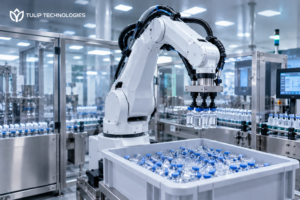
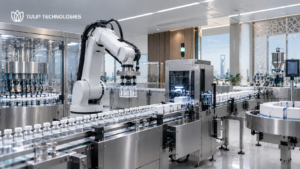
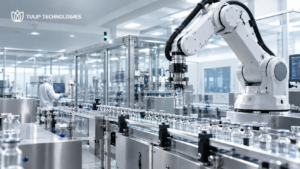
Robot integration services involve designing, programming, and connecting robotic systems with existing production processes to improve efficiency and consistency. Over time, industrial automation has evolved from simple mechanization to intelligent, interconnected systems. Today, robotics is becoming essential as industries seek precision, scalability, and cost savings. Unlike standalone robots, integrated systems work smoothly with other technologies. Companies like Tulip Technologies support different sectors such as manufacturing, logistics, healthcare, and automotive to adopt modern robotic solutions effectively.
List of Different Types of Robot Integration Services
Industrial Robot Integration
The industrial robot integration is very common in manufacturing and production environments to automate repetitive tasks and perform accurate work. These robots are used in welding, painting, work assembly, and processing materials. They ensure that manufacturers make fewer mistakes and ensure the high-quality level of production lines with greater consistency and quicker results.
Collaborative Robot (Cobot) Integration
Collaborative robot integration helps in enabling robots to safely operate in workspaces with human operators. They have modern safety measures, sensors and programming capabilities that help to improve the performance. It also supports businesses to adapt swiftly to the changing production demands and customer requirements.
Automated Guided Vehicles (AGVs) & AMRs
AGVs and AMRs are common in the field of smooth material flow and internal logistics. They transport products to warehouses and production plants with less human intervention. Such systems enhance the workflow, reduce the manual labor and improve safety in a fast-moving industrial and distribution environment.
Vision-Guided Robotics
Vision-guided robotics uses modern cameras, sensors, and artificial intelligence to help robots view, process, and respond to the environment. Such systems are popular in checking quality, detecting objects and sorting them. They improve accuracy, minimize errors and use the automation systems to perform complex tasks.
Working Process of Robot Integration: Step by Step
Step 1: Initial Consultation and Assessment
It starts with an in-depth consultation process in which specialists check the operational needs of the client, production problems, and automation objectives. This phase involves site research, data collection and consultations with key stakeholders. This will help to develop a clear picture of what is needed and what areas need to be improved using robotic integration.
Step 2: Concept Development and Proposal
In step 2, engineers develop a custom integration concept in which they describe system design, technology selection and outcomes after assessment. The complete proposal is based on cost breakdown, timelines, and expected benefits. This way, clients are clear as to how the robotic solution will suit their operational needs.
Step 3: Detailed Engineering Design
In this stage, the integration team makes correct technical designs, which are layouts, diagrams, and control systems. All the components are set up to provide compatibility with the existing systems. In most cases, simulations are carried out to verify the performance and identify potential problems before the actual implementation starts.
Step 4: System Manufacturing and Assembly
After approval of the design, the components are manufactured, assembled and made ready to be integrated. This phase involves the construction of robotic units, hardware configuration, as well as control panel assembly. Quality checks are also conducted during the process to make sure that all the parts are ready to use.
Step 5: Installation and Integration
Later, the robotic system is placed on the location of the client and is integrated with the already existing machines and processes. Engineers make sure that all its components are properly aligned, connected, and coordinated. This will reduce any kind of interruptions when preparing the system to be used in a production environment.
Step 6: Testing and Commissioning
Comprehensive testing is carried out to ensure that the system is functioning within specification. Engineers are the ones who make performance changes, correct problems, and enhance processes to achieve the desired levels of performance. Commissioning makes the system complete, reliable and capable of dealing with the real production requirements.
Step 7: Training and Ongoing Support
Lastly, the operators and maintenance personnel are trained to operate the system appropriately. Technical support services are offered on a regular basis to resolve technical problems and implement upgrades. This will also provide long term performance to ensure businesses maximize their investment in robotic integration.
Significant Benefits of Robot Integration Services
Improved Operational Effectiveness
Operation efficiency is improved significantly through robot integration, where repetitive and time-consuming work is involved. Systems operate at constant speed and accuracy, reducing all kinds of delays and interruptions. This leads to the ease of work, higher production rates, and meeting the production targets in a more predictable manner in competitive industrial environments.
Improved Product Quality
Automation reduces the possibility of human error, resulting in uniform and quality output. Robots are extremely accurate in their actions, which means that the production batches have the same outcomes. This reliability enhances brand image, reduces defects, and helps in meeting high-quality standards that are important in the current manufacturing industries.
Cost Reduction Over Time
Robot integration results in cost savings in the long term, although the initial investment might be high. Reduced labor rates, decreased wastage and fewer mistakes favor improved financial outcomes. In the long run, automation is a smart and strategic choice to make as business efficiency and productivity are enhanced.
Increased Workplace Safety
Dangerous work is handled by robotic systems, and the chances of getting injured in the workplace are minimized. Employees are no longer subjected to harmful conditions, such as lifting heavy objects or repetitive strain. This provides a safer workplace, enhances the welfare of employees, and assists the organizations in adhering to safety regulations and standards.
Scalability and Flexibility
The integration of the robots allows businesses an opportunity to adapt to the evolving production requirements. The systems can be rewritten or modified to accommodate new products or processes. This scalability enables businesses to adapt effectively to changes in the market within a short time.
Challenges in Implementing Robot Integration Services
The process of integrating robot services presents several challenges that an organization should manage. The initial cost is very expensive, and this might pose a financial burden, particularly to small and medium-sized businesses. Design, programming and maintenance are technical and demand skilled professionals. Connectivity with the existing systems can result in compatibility issues and disruptions of operations.
Another reason why automation may not be adopted quickly is employee resistance, especially when the issue of job security comes into the picture. Moreover, due to the necessity of constant system maintenance and updating, resources are necessary. It is important to overcome these challenges and record successful and sustainable automation results. As a solution, businesses must be wise in their planning, invest in training, and take a smart approach to handle challenges.
Future Trends of Robot Integration Services to Expect
Rapid technological advancement and increased demand for smart automation are the future forces behind robot integration services. The introduction of artificial intelligence and machine learning is enabling robots to be more adaptable and intelligent to modify the environment. The use of collaborative robots is on the rise because of their flexibility and safety measures.
Real-time monitoring and predictive maintenance are made possible by integration with Internet of Things systems. Further, there is an enhancement of decision-making capability by cloud-based control and data analysis. With the development of industries, the integration of robots is going to be based on scalability, performance, and unproblematic human-machine interaction in various applications.
Shaping the Future with Intelligent Robot Integration
Robot integration has become a cornerstone of modern industrial progress, driving efficiency and innovation within Industry 4.0. By streamlining operations and enhancing productivity, it delivers lasting value for businesses. With expertise from Tulip Technologies, organizations are better positioned to adopt robotics and stay competitive in an evolving global market.
Frequently Asked Questions
Which industries benefit most from robot integration?
Manufacturing, automotive, healthcare, logistics, and electronics industries benefit the most.
Are robot integration services expensive?
Initial costs can be high, but long-term savings and efficiency gains make them cost-effective.
How long does robot integration take?
It depends on complexity but typically ranges from a few weeks to several months.
Can robots work alongside humans safely?
Yes, collaborative robots (cobots) are specifically designed to operate safely with humans.