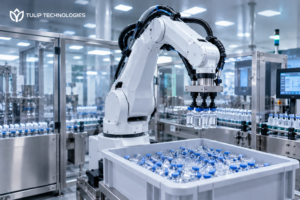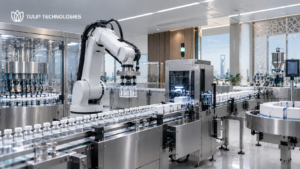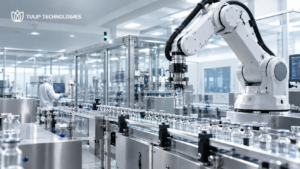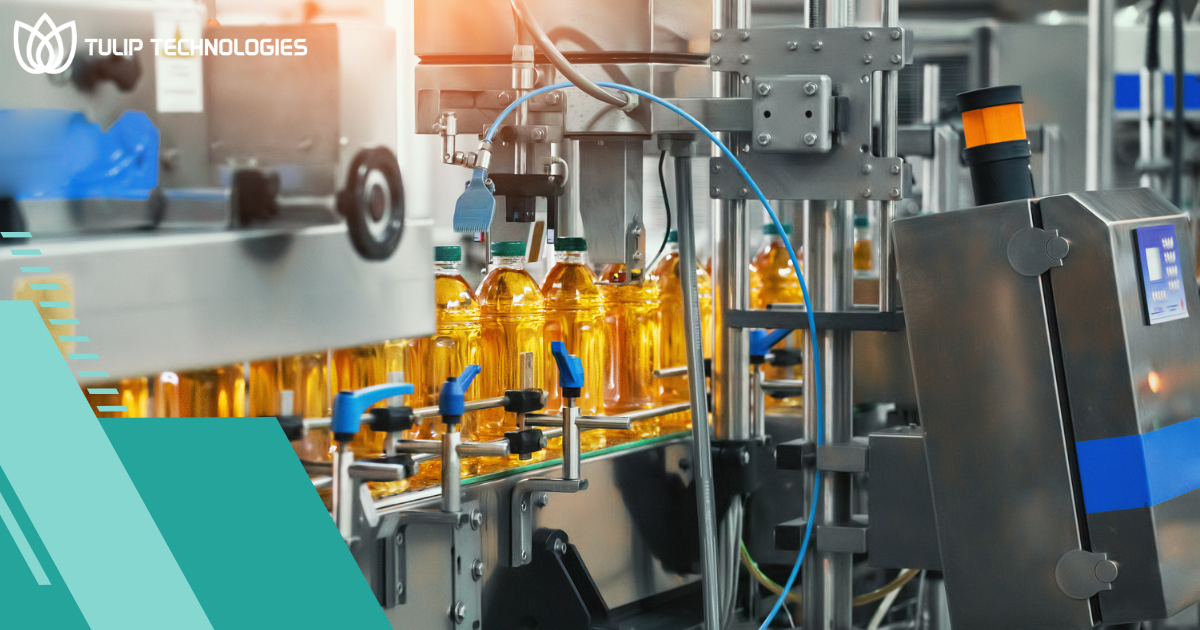
Food manufacturers in Saudi Arabia cannot afford delays at the end of the production line. Palletizing too slowly can lead to delays, putting pressure on workers and possibly causing delays in the delivery schedule. The Tulip SAED Palletizing solution provides a way to automate palletizing at the end of your production and is plug-and-play for ease of installation in 1 day. It can be done without having to stop your production process. This helps food manufacturers in KSA automate their end-of-line operations faster and improve efficiencies with palletizing. It keeps product flowing through the palletized area while keeping the production flow continuous.
Why End-of-Line Is the Last Bottleneck Standing
Mixing, filling, packaging, and quality control processes at the end of each batch. The last step is usually considered the bottleneck in an entire manufacturing chain. Because manual palletizing is slow, stacks are created inconsistently, and the process depends on the availability of labor. If operators are unable to keep up with their required output, the entire production line delays. Fortunately, palletizing is also the simplest to eliminate as a bottleneck. By automating the end of line operation, food manufacturers in Saudi Arabia can immediately boost production flow without having to change any other aspect of their manufacturing operation.
Tulip provides the SAED Palletizing system, which is a robotic solution for manufacturers of food and Fast Moving Consumer Goods (FMCG) to automate the palletizing of finished goods. The SAED robotic palletizing system picks up and stacks finished cartons, bags, or cases of the manufacturer in a specified pattern, all without respect to the operator or shift change. The performance of this robotic palletizing system is consistent from the first pallet to the last, regardless of operator availability or shift change occurring. This smart palletizing system can accommodate a variety of carton sizes and product configurations, which allows manufacturers to produce multiple stock-keeping units (SKUs) without delaying production. It reduces labor costs by eliminating the need to increase manual handling or palletizing.
Palletizing Performance Is Consistent Over Each Shift
Palletizing manually often slows down depending on the shift. In addition, palletizing tends to suffer from the effects of fatigue, both in terms of speed and in terms of stacking quality. The SAED robotic palletizing system does not have to deal with either of these issues. It is able to stack pallets with the same level of accuracy throughout the shift. As a result, every pallet that is stacked is of a uniform quality and has minimal product damage. The consistency in performance allows production managers to be able to meet their daily production output goals. It reduces the amount of errors or rework and downtime at the end of the production line.
Handles Multiple Products Without Interrupting Production
Food manufacturing facilities in KSA today seldom produce one product at a time. But they also package products in different types of packages on the same production line on a daily basis. The SAED automation system has been built specifically for this type of application. It can quickly adjust to pallet configurations and product size with no manual adjustments. It allows manufacturers to switch products quickly while minimizing any disruption to end-of-line operations and preserving total production capacity.
Installed in One Day — How That is Possible & Why It Matters
For most production managers, automation is not the primary issue. A major concern is production interruption. Any time you have downtime, that impacts delivery time, overall production output, and ultimately, your revenue. Our smart machine addresses this issue specifically by utilizing a plug-and-play design allowing for installation, integration, testing, and commissioning all on the same single day. There is no extended construction project required for your facility to take advantage of the automation benefits.
Zero Production Shutdown During Implementation
Typical traditional automation projects involve a lot of civil work, complex electrical modifications, and long commissioning periods. SAED takes a different approach. Tulip plans the installation to minimize disruption to ongoing production. The system can be cost-effectively incorporated into the existing production line without major structural modifications. Automation is more practical than risky. Manufacturers can still serve customers while upgrading their factory in Saudi Arabia.
Simple Integration with Existing Food Production Lines
Replacement of the whole production line is costly and not needed. Our automation robot is designed to interface with the existing conveyors and packaging equipment already installed in most Saudi food factories. This decreases the complexity of the project and the implementation costs. Instead of rebuilding the production area, the manufacturers only automate the final palletizing stage. The result is a faster return on investment with much less operational disruption.
Lower Labor Dependency Without Reducing Productivity
Many manufacturers still find it difficult to recruit and retain workers for repetitive palletizing jobs. Manual stacking also leads to increased physical strain and injuries in the workplace. The SAED is doing heavy palletizing work automatically so employees can do higher-value production work. Factories are less reliant on the availability of labor and maintain a stable production output each day.
Improved Pallet Quality for Better Warehouse Operations
Poorly stacked pallets cause problems beyond the production floor. They cause more product damage in transit, reduce efficiency in the warehouse, and create safety hazards. The system creates every pallet with consistent alignment and stable stacking patterns. Higher pallet quality leads to smoother forklift handling, warehouse storage, shipping efficiency, and customer satisfaction, while minimizing product losses throughout the supply chain.
A Faster Return on Automation Investment
SAED is installed in a single day, and production starts improving right away. Manufacturers start to see operational benefits much faster than with traditional automation projects. Lower labor costs, higher output, less product damage, and consistent production all contribute to a faster return on investment. Food factories in KSA can see measurable improvements almost instantly after deployment, instead of waiting months to see results.
Why Saudi Food Manufacturers Are Choosing SAED
Saudi food manufacturers need automation that operates without disruption to production. That is exactly what SAED does. It offers practical integration of reliable robotic palletizing, installation in one day, flexible SKU handling, and reliable performance. It does not just solve one problem, but improves the production flow, reduces labor dependence, protects the product quality, and removes the final bottleneck that limits factory performance. Tulip SAED provides operations managers with a fast, low-risk path to a more efficient production line in Saudi Arabia. Call Tulip Technologies today to get automation solutions for production lines.
Frequently Asked Questions
Can SAED palletizing really be installed in one day?
Yes. SAED is designed for fast, plug-and-play installation, allowing most food factories to start production with minimal disruption within a single day.
Does it work with different cartons and package sizes?
Yes. It supports multiple SKU sizes, pallet patterns, and packaging formats, making it suitable for diverse food and FMCG production lines.
Will I need to stop production during SAED installation?
No. SAED is engineered for quick integration, helping factories avoid lengthy production shutdowns during implementation.
Why should Saudi food factories automate end-of-line palletizing?
Automated palletizing improves production flow, reduces labor dependency, ensures consistent pallet quality, and removes costly end-of-line bottlenecks.