The SIRI Assessment is a structured evaluation of a factory’s operations. It identifies gaps in processes, technology and the skills of the workforce. This gives manufacturers a clearer roadmap to smart manufacturing practices. It is a way for manufacturers to eradicate inefficiencies and optimize production to provide better value.
It identifies areas in need of improvement in processes and techniques. The manufacturers thus wind up with a greater data-based understanding of what has to be done. It allows easy implementation of automation. The employees of factories have to be trained for automation, and SIRI produces better quality production of the post/modern information age. In all of these areas, it is the method by which factories prepare themselves for the advent of Industry 4.0. It provides better efficiency, less waste, and increased competitiveness in the field of smart manufacturing.
Why SIRI Assessment is Essential for Manufacturers
The SIRI Assessment is required for manufacturers who want to leverage smart manufacturing techniques. It reveals operational inefficiencies like bottlenecks and wastes of resources, but it exposes opportunities to improve production quality and maintain existing industrial standards. On the other hand, it can prepare factories for an effective transition to Industry 4.0 technology systems by mentally assessing technology preparedness, quality worker skills and the quality of data infrastructure. Altogether, these insights help manufacturers to optimize business processes, decrease production costs, enhance product quality and successfully transition to sophisticated and automated production systems.
Features and Operations That Drive Smart Manufacturing
Predictive Maintenance
Predictive maintenance utilizes sensitivity and artificial intelligent detection of machinery systems to predict potential failures before they occur. It involves the monitoring of the real-time performance of machinery systems. This allows factories to predict and reduce unproductive and costly downtime consequences that result from machinery stoppages in the equipment. For example, CNC equipment with sensitivity detection devices incorporated will generate alarms to operators of machinery when a part is operationally exhausted. If problems are corrected early, the result is more efficient production systems in efficient smart manufacturing operations because of time savings and lessening of maintenance costs.
Real-Time Production Monitoring
Real-time production monitoring captures live data from machines and production lines. This gives managers the ability to check performance in real-time. Bottlenecks and slow spots are quickly identified. For example, a dashboard tells which machine is not producing at full capacity. This allows for rapid corrections, thus decreasing downtime and increasing efficiency. Using real-time data allows factories to produce intelligently thorough, data-driven decision-making abilities. The factory can optimize workflows and obtain consistent throughput in this intelligent manufacturing environment.
Digital Twins
Digital twins are the virtual copies of a factory, machine, or process. They are perfect for helping make test changes to processes without affecting real production. For example, our team here could use a new layout for an assembly line and feed the data into a digital twin of the production line to find the best working flow for it. This will help reduce mistakes, save time, and help avoid costly interruptions. Therefore, when utilizing the data found in the digital twins, manufacturers can create the efficiency needed to optimize processes, project anticipated results, and proactively plan for upgrades. This is needed in order to deliver smooth Industry 4.0 and intelligent support for the Implementation of intelligent manufacturing processes.
Automated Quality Control
Automated quality control uses vision systems and AI systems to inspect a product for defects in real time. This is perfect for instant identification of defects. For example, in a packaging line, the cameras looking for defects could look for missing labels or damaged products. This reduces waste, increases standard consistency in the product, and assures top quality of high standards. It delivers the quality without the time lag often incurred when humans are involved in this process. Overall, it provides increased efficiency and supports the intelligent manufacturing processes; moreover, in today’s plants.
Data-Driven Decision Making
Data-driven decision-making is a method of collecting and analyzing production data to make actionable insights. This process makes the best use of resources and enhances efficiency. For instance, energy consumption data could reveal which machines use excess power. The application of knowledge gained from this insight would reduce costs, increase productivity, and limit suffering from downtime. Planning would now be smarter, and workflow management would be enhanced, resulting in greater competitiveness in smart manufacturing.
Supply Chain Integration
Integration of the supply chain digitally connects suppliers, manufacturing, and logistics. This allows manufacturers to respond rapidly to changes in demand. For example, by issuing inventory in real time, there is no chance of either overproduction or shortages. The benefits are improved planning, lower inventories, and streamlining. A factory that can pull all phases of the supply chain together enables transactions to be at peak capacity, delivers its product more rapidly. This way, it achieves greater efficiency in smart manufacturing and Industry standards.
Flexible Automation & Robotics
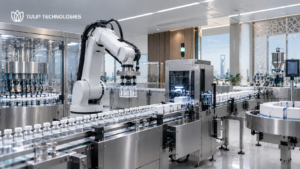
Flexible automation is that which employs robots that can be adapted to perform different workloads in a production facility. These robots can be programmed to instantly adapt to new products, thereby minimizing hand labor and the possibilities of human error. An example would be that of one robotic arm that can assemble different materials to make different items continuously on the same line with a minimum of downtime. The result is quicker delivery of product, less wastage, and greater consistency experienced by manufacturers, smart manufacturing processes, and scalability of these in modern Industry 4.0 factories.
Local Robotics Solutions for Saudi Manufacturers
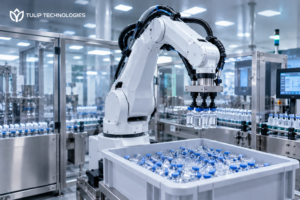
Tulip Technologies advances smart manufacturing in Saudi Arabia with the AZM industrial robotic arm. Developed with engineers in Germany, the AZM is a modular robot with up to 8-axis movement that can handle payloads of up to 40 kilograms. It can easily be programmed using user-friendly low-code programming and can be easily integrated into production lines, improving efficiency and automation in the food and beverage, pharmaceutical, and metal and manufacturing sectors.
Industry 4.0 Consulting and Smart Factory Support
Tulip helps manufacturers in Saudi Arabia through consulting, SIRI Assessment, optimizing their factories, and training their staff to use industrial robots. The analysis of their operations and the integration of IOT and AI solutions into their smart factories will allow manufacturers to make informed data-based decisions, take advantage of streamlined workflows, and improve production performance, thus allowing their factories to excel in smart factory manufacturing in KSA.
Plug-and-Play Automation for Efficient Production
Tulip provides ready-to-deploy robotic systems, including SAED for palletizing, SABEG for painting, and BARIQ for MIG welding. This modular automation solution is plug-and-play, cutting manual labor, speeding up repetitive production functions, and improving efficiencies, allowing manufacturers to easily transition into smart scalable manufacturing processes.
Why Choose Tulip for Smart Manufacturing in KSA
Tulip Technologies is your trusted partner in converting conventional factories into smart, efficient, and future-oriented production centers. By developing locally robotics, providing advice on Industry 4.0, and using plug-and-play solutions for production automation, we allow Saudi Arabian manufacturers to reduce downtimes, raise productivity, and stay ahead of global competitors. Our qualified team makes possible the uniform integration, practical support and measurable results at every level. Take the first step toward smarter manufacturing today—contact Tulip Technologies and unlock your factory’s full potential!
Frequently Asked Questions
What is a SIRI assessment?
A SIRI assessment evaluates a factory readiness for Industry 4.0 by analyzing digital maturity across various manufacturing and operational dimensions.
How to become a SIRI assessor?
To become a SIRI assessor, complete the official SIRI Assessor Training and Certification program. It includes theoretical learning, practical evaluation, and assessment exercises.
What are the pillars of SIRI assessment?
SIRI assessment is based on three main pillars:
- Process
- Technology
- Organization
Each measuring digital transformation maturity and readiness for smart manufacturing.
What is the concept of smart manufacturing?
Smart manufacturing integrates advanced technologies like IoT, AI, and automation to boost production efficiency, reduce waste, and enable data-driven decision-making.