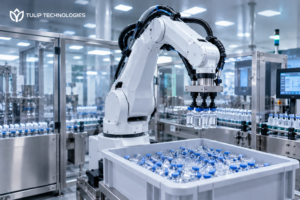
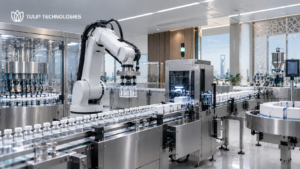
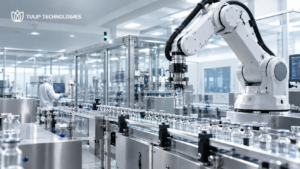
Saudi Arabia is working to change its industrial sector through the use of smart production lines. These new manufacturing plants are using automation, robotics, and data to improve manufacturing speed, accuracy, and efficiency. It is reshaping modern-day factories under Saudi Vision 2030, where businesses are now using new innovative technologies to promote local manufacturing while reducing reliance on imported goods. Smart production lines are also helping companies to lower their cost and improve quality while providing a competitive advantage to their customers globally and a developed industry economy.
Smart production lines have revolutionized the way products are manufactured through the combination of today’s latest technologies, such as automation, robotics, sensors, and a flow of real-time data. Compared to traditional manufacturing processes, smart production lines integrate multiple machines directly through an interconnected network of manufacturing systems that can communicate and collect performance data from one another.
Smart production lines utilize multiple types of advanced technology, such as IoT (Internet of Things), artificial intelligence (AI), and cloud software to facilitate more efficient tracking of production activities. It improves quality control and maintains accurate predictive maintenance forecasts. Additionally, smart production lines create faster, more accurate, and more flexible production processes, which allow manufacturers to minimize the amount of raw materials and finished goods that are wasted during the production process. This way, they are reducing the cost of goods sold by providing a consistent quality of products produced.
Why Smart Manufacturing Is Growing in Saudi Arabia?
The smart manufacturing sector continues to gain traction in Saudi Arabia due to the large governmental commitment to encouraging industrial improvement and economic diversification. The Saudi Government is focused on promoting advanced technologies through the development of new industrial cities as well as supporting automation in order to improve the level of local production. Industries have begun utilizing smart systems as a means of increasing production efficiencies, reducing overall operating costs, and ensuring the production of high-quality products. Digital transformation, increasing domestic demand, and international competition are further encouraging manufacturers to transform their production operations into smart factories.
Strong Government Support and Vision 2030
Smart manufacturing is expanding rapidly in KSA, particularly due to aspects of Saudi Vision 2030. The desire to diversify its economy and reduce its reliance on oil. The government has created a series of initiatives to develop and invest in industrial cities, technology parks, and programs related to digital transformation. These programs create a framework for factories to adopt automation, robotics, and data-based production processes. Further, authorities have created policies, along with financial incentives, that help businesses to modernize their production lines while increasing their global competitiveness.
Increase in Demand for Domestic Manufacturing
Within Saudi Arabia, there is an increasing emphasis on manufacturing products and reducing the number of goods imported from outside the country. More goods will be required due to the larger population and significant infrastructure investments. Smart manufacturing systems provide companies with the opportunity to handle the increased demand. Smart manufacturing establishes a uniform and repeatable production process for the manufacturing of goods and reduces the number of defects as a result of using automated manufacturing systems. The use of automated manufacturing systems allows large quantities of goods to be produced.
Key Features That Make Production Lines “Smart”
Role of Automation and Robotics in Smart Factories
The utilization of automated approaches and robotics forms the base of smart production lines. These operations have the capability to handle repetitive and accurate work faster than humans, as well as to reduce inaccuracies and increase the overall efficiency of an operation. A robot can work continuously, adapt to different product types, and support a higher volume of product manufacturing than a human while maintaining the same level of quality at a much lower labour cost to the manufacturer.
How IoT and Real-Time Data Increase Manufacturing
Since machines are now connected through the Internet of Things (IoT) or sensors, factories can utilize this connected technology to collect real-time data about the equipment and analyze that information. This enables the factory to evaluate the overall performance of its machines, determine whether problems are developing at an early stage, and adjust production schedules to ensure maximum production efficiency. By providing real-time information to manufacturers, they are able to reduce their downtime, increase their production efficiency, and make informed decisions. It ensures their operations run as smoothly and cost-effectively as possible throughout their entire production line.
Artificial Intelligence in Modern Production Lines
Artificial Intelligence (AI) can be used to improve smart manufacturing by providing smart production lines along with pre-determination of maintenance equipment, quality control, workflow optimization, etc. AI algorithms are used to analyze large data sets to identify patterns and predict problems before they occur, as well as to recommend improvements. AI helps improve productivity by increasing efficiency, decreasing waste, making better decisions, and providing higher-quality products.
Cloud Systems and Digital Integration in Factories
Cloud computing allows smart factories to store, retrieve, and share data about the production process from any location securely. Digital integration connects machines, applications, and supply chains into a single system so that all entities can interact with each other to improve productivity. With unified access to real-time data, there is improved coordination across the factory, and quicker decisions can be made. Cloud services allow plants to improve their productivity through streamlined processes, fewer mistakes, and more efficiently scaled operations.
Benefits of Smart Production for KSA Manufacturers
Industrial Digital Transformation
To maintain their competitiveness, manufacturers are utilizing digital transformation. Smart technology, such as IoT, AI systems, and cloud-based monitoring systems have the ability to improve the overall performance of a factory. With the use of real-time data, managers are able to monitor operations as well as reduce down time and improve overall productivity. The use of digital tools also allows for better decision making as well as optimal control of operations. As the Saudi industrial sector continues to move towards Industry 4.0 standards, smart manufacturing will be essential for industrial sustainability and innovation in the future.
Reduced Cost and Improved Productivity
In Saudi Arabia, a growing number of businesses are implementing smart manufacturing practices in an effort to decrease operating costs and increase overall efficiency. For example, automated machines can produce items more quickly and with a higher degree of accuracy than human labour. The use of predictive maintenance technology will minimise the number of unexpected breakdowns as well as reduce repair costs associated with these breakdowns. Producing products on smart production lines will reduce waste and increase resource efficiency. These benefits ultimately provide increased profit margins for manufacturers while producing consistently high-quality products.
Challenges in Adopting Smart Manufacturing in Saudi Arabia
To deploy a full robotic solution in factories in Saudi Arabia is a big challenge. Companies are slowly moving towards adopting smart manufacturing in Saudi Arabia, but there are still certain challenges to adopting it fully. The need for high initial investment cost for robotics solutions automation and advanced technologies is among challenges. This investment is made for long-term results by integrating robotics solutions with the existing system. Smart manufacturing units can also upgrade all the manufacturing environments with advanced robots. Tulip Technologies is helping businesses in Saudi Arabia with the best possible solutions. We provide customized solutions for smart automation in factories and smart production lines in Saudi Arabia.
Tulip Technologies Solutions for Smart Manufacturing in KSA
Tulip Technologies offers advanced smart manufacturing solutions designed for factories in Saudi Arabia. Their products include ready‑to‑deploy robotic systems like SAED (automation for palletizing, packaging, and case erection), SABEG (robotic painting solution), and BARIQ (robotic MIG welding unit) that automate key production tasks with plug‑and‑play simplicity. Tulip also manufactures the AZM industrial robot arm, built locally with a modular design and easy programming, helping factories boost efficiency, precision, and production speed.
Best Automation Technologies For Smart Production Lines
We offer the best automation technologies for smart production lines in Saudi Arabia. You can have expert consultation according to your production requirements and have industrial 4.0 integration, standard integration, and factory optimization. We provide fully automated machines, sensors, and artificial intelligence solutions with technical support and integration. Modernize your production lines and promote digital transformation in KSA. Well, let’s now go for the best robotics solutions that can modify your factories into smart manufacturing lines. Take a first step and book a free consultancy from Tulip Technologies today to get started.
Frequently Asked Questions
What is smart manufacturing?
Smart manufacturing means integrating the production method by using automation and robotic solutions. Tulip Technologies robots are used in smart production lines in Saudi Arabia.
How do technological solutions improve production efficiency in factories?
Artificial intelligence and cloud systems enable the management to have real-time monitoring with predictive maintenance. This way, they can easily boost productivity. These robotics solutions speed up the production volume and thus increase the profit.
Can SMEs adopt robotic solutions for smart manufacturing?
Yes, Tulip Technologies offers flexible and scalable reporting solutions that are suitable for small to medium-sized enterprises. We have custom modular robotic systems that are suitable for different sizes of factories in Saudi Arabia.
Why choose Tulip Technologies for smart manufacturing in Saudi Arabia?
We offer the best automation solution and the most advanced robotics solutions to modernize production lines in Saudi Arabia. We also provide complete technical support and integration facilities with industry assessment to ensure compliance and production quality standards.