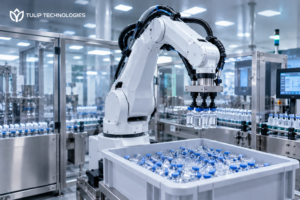
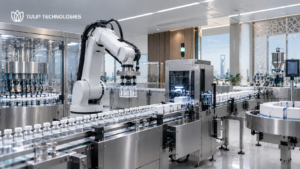
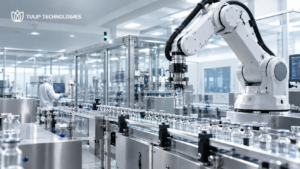
Industry 4.0 is transforming manufacturing with smart automation, connecting machines, data, and processes for more efficient operations. Collaborative robots are emerging as key players in this shift, working safely alongside humans to improve productivity. Modern production lines demand flexibility to handle changing tasks, safety to protect workers, and efficiency to meet market needs. At Tulip Technologies, we focus on providing innovative solutions that integrate automation and collaboration, helping manufacturers achieve smarter, safer, and more adaptable operations.
Cobots, also known as collaborative robots, are smart machines that are safe to work with to perform daily operations. They do not require huge safety cages, unlike traditional robots, as they help workers with their day-to-day activities, enhance speed, and perform with better accuracy and consistency. These robots have been popular in most industries by companies like Universal Robots and ABB. Above all, they are user-friendly and versatile, where they assist businesses to expand and keep the workers safe and productive. This qualifies them to be a useful component of contemporary production.
Key Benefits of Using Collaborative Robots in Manufacturing
Improved Worker Safety
These robots have safety designs that minimize the chances of injury. They can come to a stop when they sense human contact. This enables the workers and robots to work together. Consequently, organizations make the work environment safer and reduce the number of accidents.
Higher Productivity
Their working process is fast and precise. Their tasks are repetitive, and they are not tired of them. This assists the workers in concentrating on work that is more valuable. In the long run, production becomes greater, and companies can satisfy the demand of customers in a shorter time. This contributes to improved performance and robust business development.
Easy to Use and Flexible
Most of these robots are easy to install and use. Employees do not require high technical abilities. Tasks or relocation of the robots to new locations can be rapidly changed in companies. They are not only applicable to small and large manufacturers due to this flexibility.
Cost-Effective Automation
Robots do not need as much space, and they cost less compared to traditional robots. They lower labor expenses and make mistakes as well. This assists firms in saving costs and enhancing the quality of their products. Automation can be used even by small businesses without major costs.
Better Product Quality
Collaborative robots are very precise. They do things in the same manner repeatedly. This minimizes errors and enhances uniformity. Consequently, businesses produce superior products and win the trust of the customers. Waste and rework are also minimized through quality improvement.
Different Ways Collaborative Robots Help in Manufacturing
Robots play a key role in performing numerous manufacturing processes. They assist in assembly, packaging, loading machines, inspection and handling of materials. These robots help the workers to carry heavy objects and relieve physical load. They also enhance precision in work like welding and painting.
In addition, they can operate in tight areas as well as adapt to various tasks. Solutions to different industries are available in many companies, such as FANUC. They enhance efficiency and minimize downtimes by sharing work with humans. This leads to seamless operations and assists companies in giving products more quickly and of high quality.
Working Process of Collaborative Robots
These robots operate based on sensors, cameras, and intelligent software. To begin with, the robot has a user-friendly interface. Then it monitors the working space and identifies human activity. The operation involves movement through sensors that enhance safety. When an individual gets too close, the robot will either slow down or come to a halt.
Hence, they are operated according to definite instructions and repeat tasks with precision. They gather information and enhance performance in the long run. The process can be easily modified by the workers whenever necessary. This seamless communication between human beings and machines makes it more productive and helps us to make informed decisions in production.
Implementation Considerations for Using Collaborative Robots
The implementation of such robots needs to pass through different technical, organizational, and safety levels. First, businesses must evaluate task appropriateness, which involves repetitive and not risky processes. Risk assessment and adherence to standards, including ISO safety guidelines, are needed.
Change management and workforce training will assist the employees in adjusting and working well with robots. It should integrate with the existing systems, such as sensors and software platforms, with seamless integration to maximize productivity. Lastly, the constant tracking, maintenance, and performance check are guaranteeing efficiency in the long term, safety, and ROI and facilitate scalable automation plans.
Common Challenges in Using Collaborative Robots
Some of the common challenges associated with the use of collaborative robots are technical, operational and human-related challenges. High initial investment is one of the greatest challenges, particularly to small and medium enterprises. The process of integrating it with the existing production systems and software may be complicated and time-consuming.
The safety and industrial safety must be monitored and assessed accordingly to prevent the appearance of the risk. Resistance and technical incompetence among the workforce may hamper adoption, and hence, training is necessary. Applications may be limited by payload, speed and precision compared to the traditional industrial robots. Cybersecurity and data protection are also factors since robots are dependent on connected systems.
Future Trends of Collaborative Robots in Manufacturing
Collaborative robots have a bright future. More industries will embrace their usage to enhance efficiency and flexibility. The development of artificial intelligence will ensure that robots become more intelligent and user-friendly. They will be dealing with multifaceted tasks and facilitating decision-making. Digitalization and the connectivity with smart factories will increase.
Above all, they will also be used by small and medium-sized businesses. With the advancement of technology, the costs will be even lower. This will render automation to more companies. Collaborative robots will be instrumental in the development of a safe, productive and competitive manufacturing environment in the next few years.
Conclusion
Collaborative robots offer clear benefits, from improving efficiency to enhancing safety on production lines. By working alongside humans, they enable smarter, more flexible manufacturing processes. Tulip Technologies supports this vision, helping manufacturers embrace human-robot collaboration as the future of industry. Exploring such an adoption can unlock greater productivity, safety, and adaptability for tomorrow’s manufacturing challenges.
Frequently Asked Questions
Are robots safe for workers?
Yes, they include sensors, force limits, and emergency stop features, ensuring safe operation without traditional robot guarding.
How do robots differ from industrial robots?
They are lightweight, flexible, and designed for direct human collaboration, unlike traditional robots, which often require isolation and fixed programming.
Can small businesses implement robots?
They are cost-effective, easy to integrate, and scalable, allowing small manufacturers to automate tasks without huge capital investment.
What tasks can robots perform?
They handle assembly, material handling, inspection, packaging, and repetitive tasks, enhancing efficiency and freeing human workers for higher-value activities.