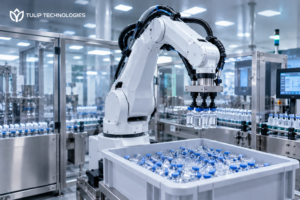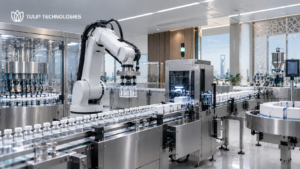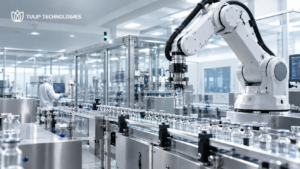
Saudi Arabia’s manufacturing sector is rapidly evolving under Vision 2030, shifting from an oil-dependent economy to a technology-driven industrial powerhouse. The Kingdom is investing heavily in smart factories, automation, and AI to boost efficiency and global competitiveness. Advanced manufacturing initiatives and digital transformation programs highlight that automation is now essential, not optional.
Tulip Technologies is supporting this transition, enabling industries to adopt intelligent systems and stay competitive in a fast-changing global market.
Rise of Smart Factories
Smart factories are becoming a major focus in the evolution of industries in Saudi Arabia. These plants employ interconnected systems, sensors and real-time information to streamline the production processes. Smart factories enhance efficiency and quality and meet the national objectives of digital transformation.
Adoption of Industrial IoT (IIoT)
The adoption of technologies of the Industrial Internet of Things is gaining momentum in all industries. Sensors and interconnected devices are constantly gathering and analyzing data, enabling companies to be aware of their operations remotely. The trend improves productivity, provides predictive insights, and allows responding more quickly to operational problems in the industrial setting.
Greater Emphasis on Workforce Digitization
Companies are putting money into digital solutions to enable frontline employees. Complex tasks are being made easier by mobile applications, wearable devices, and intuitive platforms. The productivity is not only enhanced, but training time is also reduced, and thus it is easier to get the employees adjusted to automated systems and to digital workflows.
Expansion of Artificial Intelligence in Operations
Artificial intelligence is being applied in analyzing large amounts of industrial data to make smarter decisions. Predictive maintenance, quality control, and other AI-based systems are more accurate and efficient. Organizations are using these strengths to lower the cost of operation and enhance the overall performance in manufacturing operations.
Emphasis on Cybersecurity Measures
With the growth in automation, the risks associated with cybersecurity also increase. Enhancing sound security structures is one of the priorities of Saudi industries to safeguard sensitive operational information. To guarantee safe and reliable automation in the connected industrial settings, advanced encryption, monitoring systems, and compliance standards are being implemented.
Development of Cloud-Based Automation Systems
Cloud computing is revolutionizing the manner in which industrial systems are operated. Cloud-based systems allow real-time access to data, scalability, and simpler integration of the system. The trend promotes remote work and collaboration and lowers infrastructure expenses, which makes automation more affordable to businesses of any size.
Consistency with Vision 2030 Initiatives
The Vision 2030 of Saudi Arabia is still working towards industrial modernization. Automation is important in the diversification of the economy and the improvement of productivity. The support of the government, financing schemes, and partnerships are stimulating the industries to use the advanced technologies and to accelerate the process of digital transformation.
How Tulip Technologies Enables Smart Automation?
Tulip Technologies gives power to manufacturers by offering a no-code platform that eases the process of creating industrial applications. Its user-friendly interface enables companies to computerize workflows, monitor real-time data, and enhance operational visibility without having a lot of programming knowledge. Our platform allows the integration of data and optimization of processes by connecting machines, systems, and workers.
The platform also enables quick deployment, which assists organizations to quickly adapt to the production needs as they change. This simply adds value to decision-making and efficiency with inbuilt analytics and scalability. This solution will help to close the old ways of doing things and will make automation more affordable and more efficient to industries.
Challenges in Saudi Industrial Automation
The process of automating industries in Saudi Arabia has a number of structural and operational challenges. There are numerous factories that use old systems that can hardly be connected with new digital technologies. It is also facing an issue with the lack of professionals who can handle the complex tools of automation. The cost of initial investment and cybersecurity are also some of the factors that slow adoption.
Also, there are irregular data management practices that hamper real-time decision-making. Although government programs facilitate change, it is still complicated to match the old workflow with intelligent automation. All these obstacles collectively affect the performance. It is important for the industries to implement scalable, easy-to-use and secure automation solutions to keep pace with the ever-changing, dynamic global market.
Future Outlook: What’s Next in 2026 and beyond?
In the future, the situation with industrial automation in Saudi Arabia is likely to be further developed and connected. The use of emerging technologies like digital twins, advanced robotics, and edge computing will also increase the efficiency of operations. Flexible automation systems will become more common among companies, as they are able to swiftly adjust to market needs. Upskilling of the workforce will continue to be a priority to facilitate technological progress.
Moreover, sustainability will be important, and automation will assist in minimizing energy consumption and waste. With the increased pace of innovation, the government, technology providers, and industries will collaborate to ensure continuous growth making Saudi Arabia a leader in smart manufacturing and industrial transformation across the world.
Conclusion
In conclusion, while Saudi Arabia faces challenges in modernizing its manufacturing sector, automation offers practical, scalable solutions to drive efficiency and growth. The urgency of digital transformation is clear, and companies like Tulip Technologies play a vital role as strategic enablers. To remain competitive, businesses must embrace automation and innovation now.
Frequently Asked Questions
What are the main technologies used in smart factories?
Key technologies used in smart factories are AI, IoT, robotics, cloud computing, and digital twins.
How does automation reduce downtime?
Through predictive maintenance and real-time monitoring, issues are detected early before causing failures.
Is automation replacing human workers?
Modern Industry 5.0 focuses on collaboration between humans and machines, enhancing productivity rather than replacing jobs.
How can companies start their automation journey?
By assessing current operations, identifying inefficiencies, and implementing scalable solutions like those offered by Tulip Technologies.