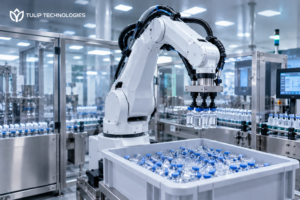
Are industrial companies in Saudi Arabia facing real challenges in deployment? You don’t worry because we have a solution. The solution is that many industries are using robotic units to solve factory problems. With the Vision of 2030, many industries are growing every day; they need to boost productivity, work quickly, improve quality, and reduce extra costs. When companies are working, if they hire skilled workers, it can be hard to find them and can be expensive.
When other new factories open, companies face strong competition. That’s why, to prevent these problems, many companies use smart machines. These helpful machines are not complicated, handle everything, make work easy, and do it daily, which also saves your time. In this article, we will discuss why companies are using robots, for what problems, the types of robots, benefits, tips, and what’s ahead.
Many manufacturers are using robotic machines now because they are an attractive investment. The government is working on the growth of new industries; companies are depending on local material, and when they hire labour, it can be expensive. They also need reliable and high-quality work in their new projects, like automotive, petrochemicals, food processing, and more. If you research robotics work, you will see it is becoming more popular in the Saudi Kingdom. For example, robots that handle materials will have a big market in 2024; when these industries improve and become more modern, this market is expected to grow further.
Solving Real Manufacturing Challenges with Robots
When production firms face many problems like expensive workers, repeated work, safety risks, and quality problems, the automation robots help to solve these problems in different ways. This automated machine does all repeated work like welding, putting parts together, and moving materials. Collaborative robots, which are also cobots, can work with people without harming them and make work faster. Industrial arm robots can handle heavy jobs.
Autonomous mobile robots (AMRs) can move materials without delays and mistakes. Vision-guided inspection robots can inspect products and find problems faster than people. When factories use these smart machines for their projects, it reduces time and money, improves safety, and boosts productivity. It also helps factories grow and turn the biggest challenges into useful opportunities.
Common real-life challenges in Saudi factories
High-volume repetitive tasks with inconsistent quality
High-volume repetitive work like welding, putting parts together, packaging, and moving materials depends on manual work. Because of this, employees become tired, make mistakes, and work poorly. It leads to inconsistent quality.
Skilled-labor shortages and rising labor costs
When companies hire skilled employees for new projects, it can be expensive and hard to find them because they need workers who can operate machines and can work for many hours, and even at night, to make new products.
Safety risks in hazardous processes
In industrial companies, employees handle different kinds of work, like hot welding, heavy lifting, chemical handling, dusty environments, and fast machines. Because of these dangerous tasks, they lead to accidents and slow down work.
Need for traceability and rapid quality inspection.
Traceability and rapid quality inspection are very important in different industries like food, pharmaceuticals, and automotive parts. If they check each product by hand, it can slow down work, and mistakes happen easily.
Inflexible lines and long changeover times
If a customer asks for a customized product, factories prepare their items in small quantities because they need to change their machine for this purpose. But old equipment and manual work make inflexible lines and long changeover times.
How robot deployment solves those challenges
There are different types of robot deployment, which solve different factory problems. Here we discuss:
Collaborative robots (cobots) the flexible helpers
Collaborative robots, which are also called cobots. They are used in different tasks like screw driving, putting small parts together, and helping with checks and packaging. They are flexible helpers. This is a strong strength of these machines because they can work with people easily, and employees can teach them new tasks quickly.
Real Benefit
There are many benefits of cobots: they make work faster, reduce errors and costs, and allow skilled employees to focus on their work. They are helpful for those industries that have fewer workers and many product shifts.
Industrial robot arms—speed, strength, repeatability
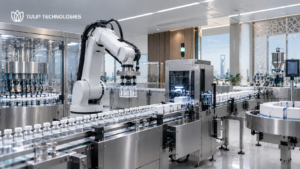
Industrial robot arms have some qualities, which are high speed, high strength, and repeatability. They have the ability to do repeated work like welding, putting parts together, packing, constructing, cutting, and helping machines, which reduces waste and downtime and improves quality.
Real Benefit
If you study these robots, you will see that these automation tools improve productivity and provide high profits for Saudi manufacturers. The main advantage is that they help factories to run their work nonstop without any delay.
Autonomous Mobile Robots (AMRs) & Automated Guided Vehicles (AGVs)
In manufacturing companies in the Kingdom, employees do their different tasks by hand, like pushing carts, moving pallets, and carrying parts. Manual work is a waste of time because Autonomous Mobile Robots (AMRs) & Automated Guided Vehicles (AGVs) do all these tasks automatically. You don’t need to worry about it because they move easily around the people and machines and deliver parts.
Real Benefit
These robots are beneficial for those companies where moving materials from warehouses to production lines is very important, like big factories, new industrial sites, and car manufacturer hubs. Because they improve productivity, reduce time and make fewer mistakes.
Vision systems + robotic inspection—consistent quality at speed
Vision robotic systems are used for checking with cameras and modern software. Their main work is to find small problems like surface scratches, shape errors, and gaps between parts. They are fast to check items and work quickly instead of doing manual work.
Real Benefit
This smart machine is beneficial for those companies that want to export and work with other Saudi industries, where a single error can damage their reputation and finances, because their main focus is consistent quality at speed.
Humanoid and specialized service robots—emerging use case
Humanoid and specialized service robots are still new and growing fast because of these qualities, like remote monitoring, working in warehouses and industries, and doing daily work. But this country is thinking of using them on a large scale or producing these robots inside the country.
Real-world outcomes: measurable wins from robot deployment
These intelligent machines give many benefits to industries that use them. And they see big improvements in three sites:
Productivity & throughput
Robots can work for many hours with a consistent quality and speed. That’s why companies accept large projects, make more products, and complete their work on time.
Lower scrap and rework
When automation robots do repeated work like welding, putting parts together, and checking products, it reduces time, money, and mistakes. It saves your material and works correctly without extra effort.
Faster scale-up
When a company depends on smart machines for big projects, it can grow faster. After that, they don’t hire new employees but also add more robotic units and trained staff, who maintain consistent quality.
The kingdom in the Gulf is investing in automation tools. They use them especially for moving materials inside the factories. In 2024, the market for these machines was big, but it is expected to grow more in 2033. This is happening at the same time when factories and industrial areas are expanding in this country.
Implementation best practices for Saudi manufacturers
If a company buys an automation robot, it should make a plan to get many advantages.
Start with high-impact, low-risk pilots.
Companies should choose those tasks that they do repeatedly and are easy to measure, like cycle time, downtime, and errors. They should test these robots on small projects, so they see their real results before using them anywhere.
Invest in systems integration.
If programmable machines connect with Manufacturing Execution Systems (MES), PLCs, conveyors, sensors, and quality platforms, they work better. It reduces extra work and keeps safe, correct data.
Upskill the workforce.
Many manufacturers provide training programs that are near the factories, and they can easily attend. They teach them how to use these machines and how to maintain and improve them. That’s why employees feel comfortable with them without any danger.
Design for flexibility
When a company makes different types of products, it needs flexible robots and machines that can be easily adjusted. For workers, factories change from one product to another in an easy and fast way.
Plan for maintenance & spare parts
Companies should check robots regularly to prevent problems. They should work with those suppliers who have spare parts nearby because if you find any issues with machines, you should solve them for smooth work.
Overcoming adoption barriers
When industries add these smart machines, they worry about three things:
Cost
The automation robots are expensive to buy. They reduce waste, make fewer mistakes, and make more items. Because of these benefits, factories recover their cost in just one to three years.
Complexity
For nearby local experts, the process of installation is simple and easy without any complexity because they know the rules of this country and how industries work here.
Workforce Concerns
When companies train their employees for new skills and expect them to have transparent communication, they can move on to important technical roles instead of losing their jobs.
Future trends Saudi manufacturers should watch
Localization of robotics manufacturing and partnerships
KSA is working on fixing robots in different industries. It reduces time and allows factories to get these machines according to their needs.
AI-driven quality & predictive maintenance
Industries will use artificial intelligence and smart machines to find problems instantly and predict when a machine will break down. With it, work doesn’t stop.
Robots as part of digital supply chains
Robotic equipment will be connected with suppliers, warehouses, and production lines. They share important information with them. It will reduce delays and keep work smooth.
Tulip Technologies Robotics that Fit Saudi Factories
If you are thinking of investing in automation robots, you can trust Tulip Technologies because it grows fast. We offer complete solutions according to industry needs. We provide cobots, industrial robot systems, and moving material robots, which give full support, trading, and service. With Tulip’s end-to-end solutions, factories work faster, follow local requirements, and reduce mistakes. If you are interested, you can contact us today!
Conclusion
If companies have automation machines in their workplaces, it doesn’t mean that these smart machines handle all the work. Industries used these machines to solve their problems, like inconsistent product quality, slow movement of materials, safety issues, and difficulties in making products. We offer proper planning, proper setup, and employee training. With all these advantages, these robotic machines work faster, reduce mistakes, and become competitive in the industries of Saudi Arabia.
Frequently Asked Questions
Do robots work for small manufacturers in Saudi Arabia?
Yes. Factories are using smart machines in this country. For small manufacturers, collaborative robots and modular robots are the best options. If you start, it should cost less.
How long until a robot pays back its cost?
A robot pays back its cost within one to three years because they are expensive, reduce waste, make fewer mistakes, and produce more.
Will robotics mean job losses?
No. Robotics doesn’t mean job losses because companies train their workers for new skills, like programming, supervising, and maintenance.
Which industries in Saudi Arabia benefit most from robots?
In this kingdom, different industries get benefits from them, like automotive, food and drinks, medicine, petrochemicals, general assembly, and warehousing.
How do I choose the right integrator or robot partner?
If you are looking for the right integrator for your industry, you can choose Tulip Technologies because it is the best option. We have many years of experience, offer staff training and local support, and set up robots in your factory.