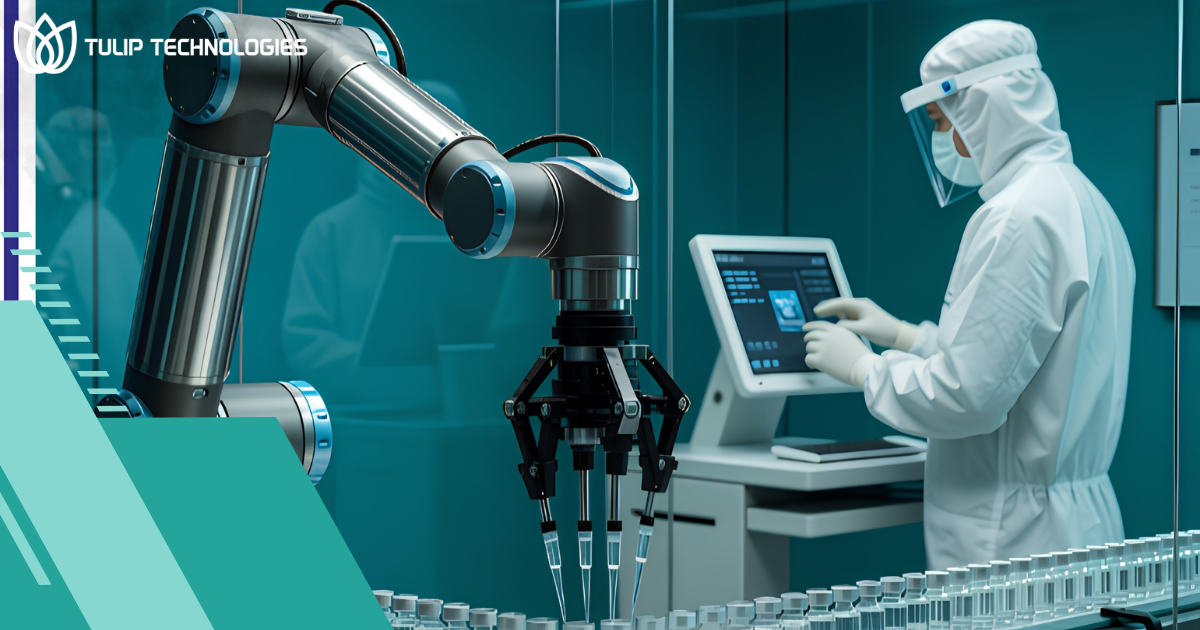
The sterile production process is rapidly developing in Saudi Arabia. In order to be authorized by the Saudi Food and Drug Authority (SFDA) as well as to adhere to Good Manufacturing Practices (GMP) standards, pharmaceutical companies and manufacturers of medical devices need to follow the policy. One of the main threats to sterile production is human contact, because people are the way for bacteria, skin particles, and hair to penetrate the products even while wearing purified uniforms. Thus, reducing such kinds of contact may help to ensure high quality and safety of products produced in accordance with sterile principles. At present, Saudi producers focus on the implementation of different technologies, including robotics, automation, and remote monitoring equipment. These methods are very helpful to reduce human contact in sterile manufacturing. Let us discuss it in detail.
Sterile manufacturing means that the product is produced in an absolutely sterilized environment. Sterile manufacturing is applied in the pharmaceutical industry as well as in the production of medicines and medical devices. In Saudi Arabia, manufacturers of medicinal products produce injections, eye drops, and infusions through the sterile production process. It is performed in cleanrooms where temperature, humidity, and ventilation are controlled. Each and every step of the process – mixing and filling – should be done without contamination.
Why Reducing Human Contact Matters in Sterile Manufacturing
Sterile manufacturing means that the product is produced in an absolutely sterilized environment. Sterile manufacturing is applied in the pharmaceutical industry as well as in the production of medicines and medical devices. In Saudi Arabia, manufacturers of medicinal products produce injections, eye drops, and infusions through the sterile production process. It is performed in cleanrooms where temperature, humidity, and ventilation are controlled. Each and every step of the process – mixing and filling – should be done without contamination.
What Are the Main Sources of Human Contamination?
Human contamination in cleanrooms comes from several factors. Skin, hair, saliva, and sweat are considerable dangers. Breaking dressing regulations may lead to the contamination of clean zones. Even speaking near open products may mean that bacteria will be spread through aerosol forms. Movement of feet along one’s own body will change air and raise the count of particles. In sterile production facilities, special training of workers can help reduce hazards but cannot prevent them completely.
How Automation Reduces Human Intervention in Sterile Production
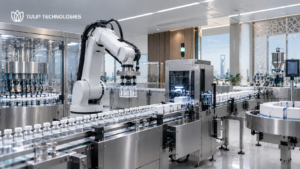
Automation replaces manual labor with machinery and robotics. Processes such as filling, capping, and packaging can be fully automated. Automated installations operate on a precise and repeatable basis, thereby minimizing the risk of contamination and human error at the same time. Saudi manufacturers apply automated systems in order to comply with SFDA regulations and international standards for good manufacturing practices. Automated production lines are also able to increase production efficiency while reducing production costs. The actions of the automated systems are supervised by modern sensors and software.
Robotics in Sterile Materials Handling
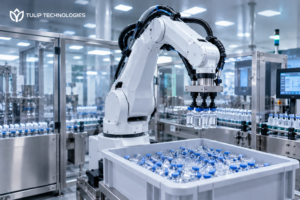
Robotics may be utilized for moving, loading, and transferring sterile materials. Robot arms are engaged in handling vials, syringes, and containers without human touch. The application of robotics minimizes the contamination risks while ensuring the steady pace of production. Additionally, robots perform their duties with no fatigue or human error. Robotics is applied in many processes at Saudi Arabian pharmaceutical plants, such as loading isolators or transferring components. At the same time, robotics allows decreasing the number of operators in the cleanroom. AZM is Saudi Arabia’s first fully manufactured industrial robot arm proudly developed by Tulip Technologies. Key Features include;
- Developed and manufactured entirely in Saudi Arabia
- Modular design with up to 8-axis movement
- Handles payloads up to 40kg with a 2500mm reach
- Easy to program (low-code or no-code)
How Isolators and RABS Minimize Human Contact
The technology of isolators as well as the technology of RABS (Restricted Access Barrier Systems) provides a way of effectively separating the production employees from the sterile products. Due to the fact that isolators use a fully enclosed environment, the product processing happens in a completely sealed environment, while RABS provide a semi-enclosed barrier with strict access requirements. Both isolators and RABS can be used with gloveports that limit the interaction of humans with the product. These technologies definitely contribute to contamination reduction compared to open cleanroom facilities. Production facilities in Saudi Arabia have been applying both technologies for aseptic filling procedures. Such technologies help meet the requirements of SFDA and EU GMP Annex 1. In modern sterile production facilities in Saudi Arabia, isolators and RABS have become a common phenomenon in the manufacturing process.
The Functionality of Automatic Filling and Sealing Systems
The technology of production countries refers to aseptic filling systems without human touch. The automatic system fills containers such as vials and ampoules. As the filling process is done, the sealing happens to avoid any exposure. Such technology minimizes contamination during such sensitive phases of manufacturing. Pharmaceutical companies in Saudi Arabia apply aseptic filling systems for producing vaccines and injectable preparations. Apart from this, the technology decreases waste and increases the consistency of production batches.
How Cleanroom Design Helps Reduce Human Intervention
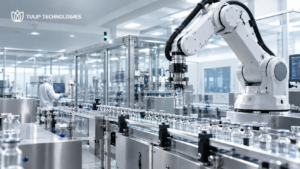
A well-designed cleanroom minimizes unnecessary human movement and contact. Unidirectional airflow directs negative pressure away from critical areas. Separate entrances and exits help prevent cross-contamination. Cleanrooms fitted with isolators require fewer operators to wear gowns. Saudi cleanrooms comply with the ISO 14644 standard and the Saudi Food and Drug Authority’s cleanroom grades. A proper layout also helps streamline the work process. Automatic transfer stations further reduce the need for human labor. Careful planning and design of a cleanroom is the first step to implementing a strategy for low-contact sterile manufacturing, especially in the context of the ongoing construction of pharmaceutical factories in Saudi Arabia.
Using Remote Monitoring to Control Sterile Processes
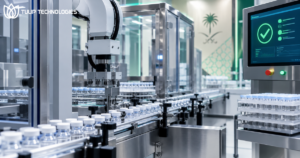
Remote monitoring allows for controlling the production process while remaining outside the cleanroom. Thanks to cameras, temperature and pressure sensors, and software, temperature, pressure, and particle counts can be monitored remotely. As a result, production staff do not need to enter cleanrooms for setting adjustments. It minimizes the number of people present inside the cleanroom. Some pharmaceutical firms in Saudi Arabia use remote systems to ensure a permanent production process, which results in digital records being made for audits and inspections.
How AI and Smart Sensors Improve Contamination Control
The dangers associated with contamination are monitored in real-time using artificial intelligence and smart sensors. The sensors monitor air quality, particle levels, and equipment efficiency. The AI software anticipates the occurrence of possible problems before they emerge. This has minimized the need for manual inspections of cleanrooms. AI technologies are being utilized within Saudi Arabia to realize digital manufacturing visions as part of Vision 2030. The other function of smart sensors is the provision of data as part of reports to SFDA. In addition to demonstrating high levels of performance, AI technologies also help reduce human inputs in the process.
Best Practices for Minimizing Operators' Interventions
Minimization of operators’ involvement in operations requires the application of different technologies. It is advisable to apply isolators or RABS during high-risk sterile processes. Filling, sealing, and packing operations should be automated. Training of operators in rigid and strict gowning and hygiene rules is an important part of the process. It is of utmost importance to keep the number of people working in critical zones to a minimum. Remote monitoring should be applied in as many cases as possible. It is necessary to analyze contamination incidents by regularly going through reports. Saudi manufacturers implementing these suggestions have reduced cases of contamination significantly.
Regulatory Considerations for Minimizing Human Contact
SFDA controls very strictly for sterile manufacturing facilities in Saudi Arabia. The guidelines are very similar to EU GMP Annex 1. Facilities must have well-documented contamination control strategies. Isolators, RABS, and automation have to be validated before use. Cleanroom classifications and gowning procedures are checked with regular audits. Failure to comply can result in warnings, fines or stoppages of production. Saudi manufacturers must keep up-to-date records for inspection. Understanding these regulations helps companies make the right call on automation investments. Compliance is not optional; it is necessary for the legal operation of sterile plants in the Kingdom.
How to Build a Low-Contact Sterile Manufacturing Process
The first step in constructing a low-contact process is a clear risk assessment. Determine all the points of human contact today. Replace manual labor with automation or robotics wherever possible. Add isolators or RABS for high-risk aseptic steps. Remote monitoring eliminates physical cleanroom checks. Train staff on strict gowning and entry procedures. Review data regularly to find new opportunities for improvement. Saudi manufacturers should plan this in a stepwise manner, dealing first with the highest risk areas. A phased approach cuts cost, improves safety and compliance over time.
Contact Tulip for Automation Solutions for Sterile Manufacturing in Saudi Arabia
Tulip provides robotic and factory automation solutions to meet the needs of sterile manufacturing. Our robotic machines allow Saudi pharma companies to reduce human contact in a safe manner. We support digital monitoring, process control, and compliance documentation. Tulip’s smart tools & robots work in tandem with isolators, RABS, and robotic systems. Our smart automation system is used by manufacturers to track data and comply with SFDA. Whether you are building a new plant or upgrading an existing one, Tulip can help. Under the direction of the Industrial Center, Tulip Technologies proudly developed AZM, the first completely produced industrial robot arm in Saudi Arabia, in partnership with top German partners Roboco and WZL. Contact our team today to learn how automation can improve your sterile manufacturing operations in Saudi Arabia.
Conclusion
Safe sterile manufacturing requires less human contact. Automation, robotics, isolators, and AI would be used. The pharma sector in Saudi Arabia is rapidly adopting these technologies. They help comply with SFDA regulations and worldwide GMP standards. Less human contact means less risk of contamination and better product quality. It also makes production more efficient and faster. With Vision 2030 driving local manufacturing growth in Saudi pharmaceutical and medical device industries, low-contact sterile production will become the norm.
Frequently Asked Questions
What is the main risk of human contact in sterile manufacturing?
Humans shed skin cells, hair, and bacteria even in cleanroom suits. This is the biggest contamination risk in sterile production. Automation and isolators help reduce this risk significantly.
What is the difference between isolators and RABS?
Isolators are fully sealed systems with no direct room air exchange. RABS are semi-open barriers with more controlled access. Both use gloveports, but isolators offer stronger contamination control.
Does SFDA require automation in sterile manufacturing?
SFDA does not mandate automation directly. However, it requires strict contamination control and GMP compliance. Automation is the most reliable way to meet these standards consistently.
How can Saudi manufacturers start reducing human contact?
Start with a risk assessment of manual steps. Then add automation, isolators, or remote monitoring to high-risk areas first. A phased approach keeps costs manageable while improving safety.