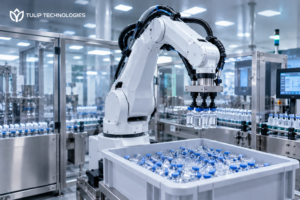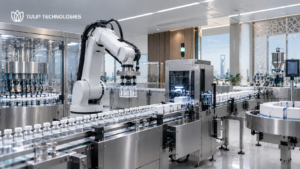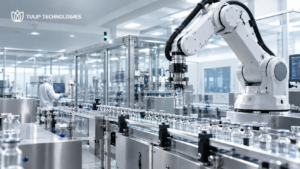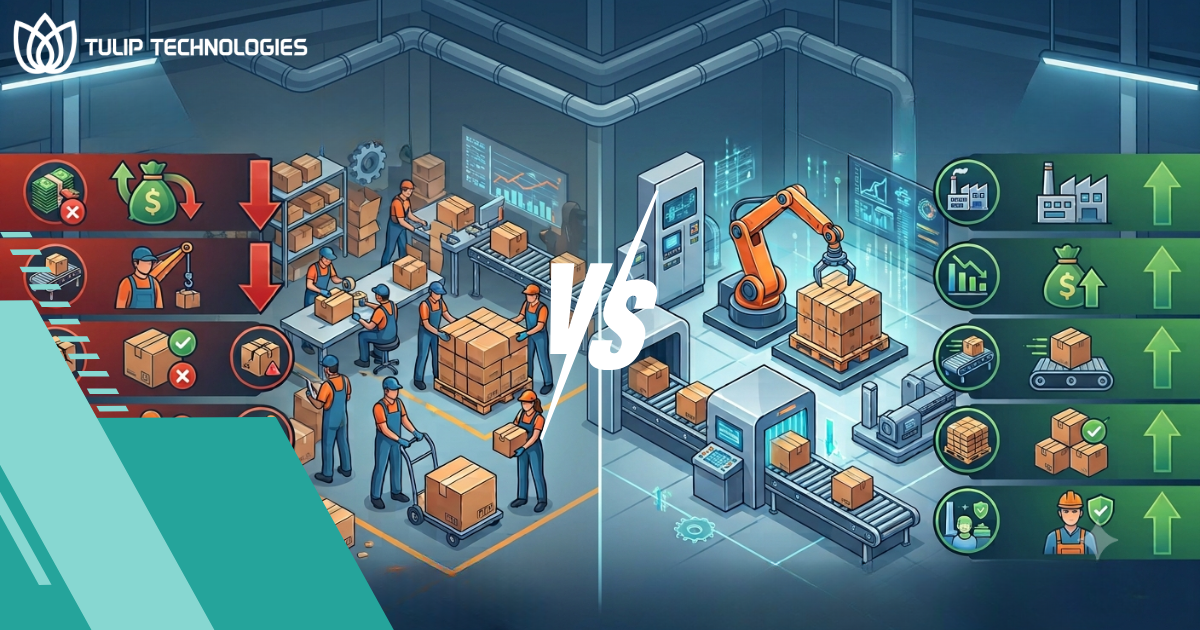
Choosing between a manual and automated end-of-line process is not as simple as comparing equipment costs. It is not always a simple question when considering whether to use a manual or automatic end-of-line process; simply comparing the initial cost of the equipment is not the answer. Many FMCG manufacturers in Saudi Arabia find that the highest cost typically occurs due to hidden production inefficiencies, production delays, labour shortages, output variability, product damage, and missed deliveries to customers.
Even though you may see the manual operation as a lower cost option early on, when looking at the overall impact on productivity and operating costs. Many miss the overall costs associated with the two performance methods over time. In order to fully understand which of the two methods provides you with the best value proposition, it would be valuable for you to gain insight into how these costs will affect factory productivity in the future. In addition, you need to understand their true cost based on the two different methods.
What Does "End-of-Line" Actually Mean in an FMCG Factory?
Production’s final step is referred to as the “end-of-line” and is when the finished product is ready to leave the factory to be stored or shipped. The activities performed at the end-of-line include: pitching cardboard boxes, packing products in cartons, sealing cartons, sorting or separating products by type, stacking products in pallet loads for shipping, and getting the products ready for shipping.
These events take place at the end of production. They influence the speed with which products are manufactured on the entire line. If any of the activities at the end-of-line slow down, production rates upstream of the end-of-line will be negatively impacted. Production will stop until the end-of-line can catch up, resulting in a bottleneck that slows your factory down.
In many cases, these activities are reliant on manual labor. There are a large number of workers lifting cartons, stacking products onto pallets, organizing the finished goods, and preparing shipments, often in shifts throughout the day. Although these activities appear to be routine to those who perform them, these activities are typically the busiest and heaviest physical portions of production. Because volume is continuously increasing in fast-moving consumer product manufacturing, manual end-of-line operation continues to be one of the primary constraints on output, consistency, and operational efficiency in daily production.
The Real Cost of Manual Stacking and Packing Goes Beyond Labor Wages
When factories evaluate manually operated costs, they almost always concentrate on the direct labor costs. However, salaries represent only a small percentage of the overall costs. Repeatedly lifting items and stacking pallets have high levels of physical stress associated with them, leading to an increased likelihood of musculoskeletal and other injuries occurring. Injuries of a relatively minor nature cause sick days, temporary replacements, and reduced worker productivity, which ultimately results in increased insurance costs or compensation costs for the employer. When production levels are at their highest level, losing experienced operators can have effects on daily output.
Production Consistency
Production consistency is another hidden cost of a factory. Different shifts automatically stack pallets at different rates and different heights. This variance in stack height can also be attributed to individual operator performance, i.e., some operators prefer to complete tasks quickly while others take a more accurate route. If the pallets are not loaded evenly, there is an increased risk of product being damaged during transport, as well as increased handling issues within the warehouse due to pallets being loaded unevenly. The cumulative effect of small variations on each shift results in decreased production and increased need for inspection and rework activities.
Hygiene Risks
The hygiene risk associated with manual handling is amplified at all critical points of production. Each time an item is physically touched by a person increases the risk of contamination. In food and beverage manufacturing, strict hygiene standards must be maintained. Multiple operators working across multiple shifts and production schedules lead to a greater inability to consistently meet SFDA requirements because of reliance on manual movement of products.
Overtime Manual Production
During peak production periods, when customer demand increases, factories often need to depend on overtime to be able to meet shipment schedules. Overtime leads to increased labor costs, while an increased amount of time working results in fatigue, which leads to lower productivity and accuracy. Although factories are paying more in labor costs, they experience difficulty producing enough product because manual handling has a maximum amount of physical output that can be produced safely.
Example
For example, consider a production line experiencing a processing speed of 1,200 cartons/hour. The line could lose up to 8% of its capacity due to either slower-than-normal manual stacking, operator breaks, or staff shortages. The number of cartons lost per week due to these specific reasons could be thousands, on top of this. These hidden costs go far beyond the hourly wage of each operator working at the end of the line.
The automation process is specifically designed to reduce production procedure variations rather than simply replace manual work. It is a better way to take advantage of consistency. Automation makes the process of stacking and palletizing have the same speed and quality whether it is done in the morning, evening, or on any schedule. Automation fixes the specific patterns to follow for the pallets, which definitely reduces damage and low-quality products made. Automation in the Saudi production lines also supports the best hygiene standards because there is no need for direct product handling during the packaging steps. There are fewer chances of manual touchpoints, which definitely reduces the risk of contamination. This way, the production lines can easily follow quality assurance, quality inspection, and regulatory compliance. This way, the factory owners can produce a greater volume of quality products, and customer quality expectations increase.
Modern production units in Saudi Arabia are deploying smart automation that can be installed alongside existing equipment. Supervisors and operators can monitor daily operations without the need for advanced programming information. However, to implement automation in factory production, you also need upfront capital investment, proper commissioning of the machines and equipment, and careful planning. Small units find it hard to achieve their targets and cannot get their objectives immediately. However, you need to decide things according to your production volume, source availability, and labor. This way, you can manage total operational costs better.
How to Calculate Whether Automation Makes Sense for Your Factory
To estimate automation cost, you can simply calculate it. There are different things you have. Are you curious to have a realistic overview and starting point to know whether automation makes sense for your factory or not? There are three important factors to consider.
- Daily operating hours
- Average units produced per hour
- Estimated production loss caused by manual slowdowns
As an example, take a production line that operates for 16 hours daily, producing one thousand units of product each hour. The capacity of this line in one day is sixteen thousand units. If there are any delays at the end of the line due to manual processes that cause production to be reduced by even just 7%, then over time you will incur a loss of approximately one thousand one hundred twenty (1,120) units in potential daily production lost from your total daily output. This daily amount multiplied by three-hundred operating days results in an annualized loss of more than three hundred thirty thousand (330,000) units of inventory produced from that production line.
This does not factor in overtime, product damage, labor shortages, shipment delays, or quality-related re-work. Therefore, when considering these other costs, the financial impact is far greater than managers typically anticipate. Production managers in factories in Saudi Arabia can understand the true cost of their operations to justify automation in the required situation. They can compare the alternative solutions by themselves before deciding. Better decisions taken with the help of data insights are stronger than decisions based on solving equipment prices. So, have a deep review of the different factors that are associated with cost, and then have a cost estimation to overall consider if the automation process fits your required phases or not.
3 Questions to Ask Before Making Your Decision
Consistently verify that a supplier’s product is viable for your operation prior to considering their product for a project that requires or could need help with a future project. This will be when you are making the purchasing decision.
1. What is your current production line’s expected downtime during installation?
Installation times can result in lengthy periods of downtime for your entire manufacturing and could cause delays in shipping to your customers. Look for vendors whose products enable you to integrate into your existing operations with minimal downtime.
2. Is there extensive training required to operate the equipment or software?
Factory supervisors’ time is best spent managing their operations, as opposed to learning how to use complicated software platforms. Quality equipment can be defined by simplicity of control, ease of use, and training requirements.
3. Are you being provided with locally engineered support for the equipment you are purchasing?
When production schedules get tight, the availability of local engineering support, spare part availability, and quick technical support become very important. Suppliers who have local resources, understand local regulations, and know how to operate within Saudi manufacturing’s culture usually have significant advantages and provide increased reliability over time. Tulip Technologies offers complete technical support and inspection of systems in factories in Saudi Arabia.
Manual or Automated? The Right Answer Depends on Your Factory
While automation is available for every FMCG production line, using an automated solution is not always the best solution. Smaller plants with lower production volumes and stable availability of labor are still able to run the plant in an efficient and cost-effective manner without automation. However, if a plant suffers from issues such as experiencing labor shortages, inconsistent production output, overtime costs for labor, repetitive handling, or experiencing bottlenecks at the end of the line, it is time to look at a new method of operation. Conclude it through the collection and analysis of actual production data, as opposed to operational assumptions.
The end goal is not simply to reduce the amount of labor used to produce your product. The ultimate goal of a new manufacturing method is to achieve increased production consistency, stabilize the production of your product, protect the quality of your product, and implement a manufacturing method for better results. It helps the objectives be achieved while also preparing your company for future growth, without adding unnecessary complexity.
Not Sure If Automation Makes Sense for Your Line?
Each manufacturing facility operates differently. Therefore, the optimal decision should always reflect the particular procedure used in a production environment and not be based upon an unrealistic sales presentation. At Tulip, we provide free operational assessments to determine if the benefits of end-of-line automation can apply to your manufacturing facility. No obligation exists with these assessments, but it does provide a sufficient amount of relevant knowledge to make productive decisions.
Final Words
There is no single answer that fits every FMCG factory. For KSA businesses with low production volumes and stable labor availability, manual end-of-line operations may still be practical. However, as production grows, the hidden costs of manual stacking, packing, labor dependency, overtime, inconsistent output, and compliance risks often become much greater than expected. Automated end-of-line systems require an upfront investment, but they deliver consistent performance, higher productivity, improved product quality, and lower long-term operating costs. When evaluating the total cost of ownership instead of just the purchase price, automation is often the more cost-effective and sustainable choice for high-output FMCG manufacturers. Choose Tulip Technologies to have production automation solutions in Saudi Arabia.
Frequently Asked Questions
Is automated end-of-line always better than manual operations?
Not always. It depends on your production volume, labor availability, operating costs, and long-term growth plans.
What are the biggest hidden costs of manual end-of-line operations?
Beyond wages, manual processes can increase overtime, product damage, labor shortages, inconsistent output, workplace injuries, and production downtime.
How do I know if my factory is ready for end-of-line automation?
If manual bottlenecks regularly slow production, increase costs, or affect product quality, it may be time to evaluate automation.
Can end-of-line automation improve production consistency?
Yes. Automated systems deliver consistent stacking, packing, and palletizing speeds, helping reduce variation, improve product quality, and maintain steady production across every shift.