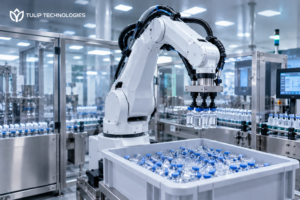
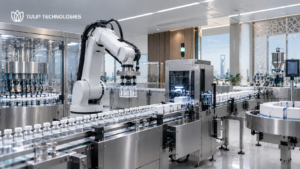
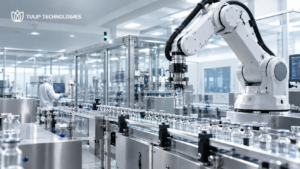
Smart factories employ technology to manage and improve the production process through the connectivity of equipment, software, and data, forming an interconnected and intelligent system. Whereby sensors are used to gather quick data regarding the performance of machines. Systems analyze this data for immediate decision making that results in improved speed, accuracy, flexibility, and increased efficiency for production while also reducing the amount of manual labor used with a higher level of control. Smart factory automation is increasing productivity greatly. It is a great industrial development in Saudi Arabia. Let us discuss how it is advantageous.
Traditional manufacturing processes typically rely on a manual-based system with fixed methods and are limited by the level of real-time visibility and flexibility available. Therefore, traditional manufacturing facilities often experience delays, a high percentage of defective goods (caused by human error), and perform maintenance as a result of failures. On the other hand, a smart factory employs automation and connectivity through the use of machines that continuously monitor and are capable of being adjusted more readily based on data analysis. This ultimately allows for decreased downtime, greater efficiency, and a more powerful modern manufacturing facility with the ability to be expanded as required.
Core Components of Smart Factory Automation
Industrial Internet of Things (IIoT)
Industrial Internet of Things (IIoT) connects machines, devices, and systems together on the factory floor, creating a way for equipment to exchange real-time data with software platforms. By improving the monitoring of equipment for predictive maintenance and continuous optimization of production processes, IIoT provides greater speed and accuracy in manufacturing operations.
Sensors, Actuators, and Connected Machines
Operations data are gathered using sensors, while actuators carry out system commands based on sensor data collected by them via their own output. The IIoT devices that help collect and send out this data also allow for the communication between all connected machines to maintain coordinated operations. It provides better control of functions and a consistent quality of products manufactured throughout the entire facility.
Robotics and Autonomous Systems
Automating repetitive tasks with robotics is a major part of smart manufacturing. Robot systems run autonomously (without ongoing human intervention) to produce items quickly, accurately, and safely. They can also quickly accommodate changes in production or adaptation to more complex manufacturing techniques.
Manufacturing Execution Systems
Manufacturing Execution Systems link planning systems to the shop floor by providing real-time information on production, managing workflows, and monitoring compliance with quality criteria. Therefore, providing manufacturers with improved visibility, increased throughput, and greater control over their entire manufacturing process.
Cloud Computing and Edge Processing
Cloud computing provides scalable storage and analytics capabilities that can be used together with edge processing to reduce the system latency of an automated factory. It allows for faster, more real-time decision-making. Both of these technologies increase security and flexibility.
How Smart Factory Automation Works
Data Collection from Machines and Equipment
Data from machines collected through sensors and devices that connect to the internet includes machine performance as well as status and operating conditions. The continuous collection of this data provides a sound basis for monitoring, analysis, and informed decision-making throughout the manufacturing process.
Real Time Monitoring & Control of Processes
The data that is collected is monitored in real-time through centralized systems. It provides operators with immediate visibility into the status of production. Automated process control facilitates automatic adjustments to manufacturing processes to prevent product failure, maintain quality standards, and achieve a consistent level of production performance.
Automation of Production Workflows
Automated systems coordinate actions across machines and production lines with little or no human involvement. It helps lead to fewer mistakes, faster throughput, and consistent execution of established processes that comply with pre-set rules, timelines, and quality standards.
Machine-to-Machine Communication
Through wired or wireless networks, machines are able to communicate directly with one another and exchange data, commands, and status updates without the need for any operator input. By providing this level of coordination, machine-to-machine communication improves efficiency by reducing downtime. It allows companies to deliver more efficient and useful production processes.
Continuous Feedback and Improvement
Data collected from performance metrics of an automated system is processed by that same automation system to determine what aspects of the system can be improved. The resulting recommendations provide a continuous feedback loop to help companies reduce waste and improve their operational efficiency over time through the continuous improvement of their procedures.
Role of Artificial Intelligence in Smart Factories
AI primarily contributes to the performance of smart factories through the analysis of vast quantities of operational data when using AI to help anticipate equipment failure early. Various other technologies, such as using computer vision for quality assurance, can identify defective products immediately. AI can also improve manufacturing performance by providing more accurate demand forecasting, thus improving production planning.
Through intelligent decision-support systems that optimize the use of resources, schedule productivity, and optimize work processes. Overall, each AI-enabled capability contributes to improving manufacturing performance, decreasing downtime, and increasing product quality. It supports manufacturing operations that are based on data.
Benefits of Smart Factory Automation
Smart factory automation improves efficiency, accuracy, and product consistency while reducing downtime and maintenance costs. Automated assembly lines, smart inspections, and inventory systems streamline operations. Energy and asset management optimize resource usage. Real-time supply chain integration improves coordination. Secure data exchange and integration with ERP and SCM platforms ensure smooth operations. Strong cybersecurity measures protect automated environments, enabling safe, reliable, and scalable manufacturing systems.
Data Security and System Integration in Smart Factories
Smart factories rely on secure data exchange between machines, systems, and cloud platforms. Integration with ERP and SCM systems ensures seamless workflow and operational visibility. Strong cybersecurity measures protect against breaches, protect sensitive information, and maintain safe, uninterrupted manufacturing processes across automated environments.
Challenges in Implementing Smart Factory Automation
Implementing smart factory automation requires a high initial investment and can face compatibility issues with legacy systems. Workforce upskilling is essential to manage advanced technologies, while complex data management adds another layer of challenge. Organizations must plan carefully to overcome these obstacles and ensure the smooth integration of automated processes.
The Future of Smart Factory Automation
The future of smart factories in Saudi Arabia is shaped by Industry 4.0, fully autonomous production, and digital twin technologies. These innovations enable real-time simulation, predictive insights, and fully connected manufacturing environments. Factories will become more efficient, adaptive, and intelligent, driving continuous improvement and sustainable growth. Tulip Technologies helps factories in KSA with smart automation. Adopt AI industry vision and integrate your factory with robotics solutions.
Modify Your Factory with Smart Automation
Tulip Technologies empowers manufacturers to embrace the full potential of smart factory automation in Saudi Arabia. From real-time monitoring to AI-driven predictive maintenance, our solutions simplify operations, improve performance, and boost product quality. Integrate systems smartly, reduce downtime, and make data-driven decisions with confidence. Upgrade your manufacturing environment today and stay ahead in the Industry 4.0 era.
Frequently asked questions
What is Tulip Technologies?
Tulip Technologies is a smart factory platform that connects machines, systems, and workers to optimize production processes.
How does Tulip improve factory efficiency?
It automates workflows, monitors operations in real time, and uses AI to predict maintenance needs, reducing downtime and errors.
Can Tulip integrate with existing ERP or SCM systems?
Yes, Tulip is designed to seamlessly integrate with ERP, SCM, and other enterprise systems for smooth operations.
Is Tulip suitable for small and large manufacturers?
Absolutely. Tulip Technologies scalable solutions support Saudi factories of all sizes, from single production lines to large industrial operations.