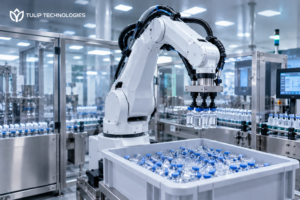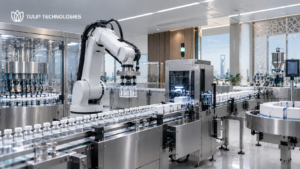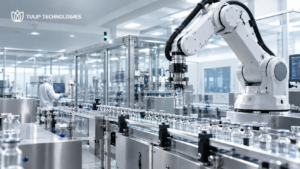
Vision 2030 is pushing a strong shift toward industrial automation, helping nations move beyond traditional economic models and adopt a new technology-led future. By integrating robotics, AI, and IoT, industries can improve efficiency, accuracy, and scalability while lowering operational costs. Tulip Technologies supports this shift by providing smart, connected solutions that empower modern manufacturing. As automation advances, it creates new opportunities for innovation, workforce development, and long-term sustainable growth globally.
Vision 2030 is a long-term strategy aimed at revolutionizing the economies into more diversified, powerful, and knowledge-driven systems. Its main purpose is to lessen its overall reliance on oil revenue and develop more areas of growth based on non-oil activities. This vision focuses on taking part in the private sector, advancement of technology and developing a well-trained and powerful workforce to show results in long-term growth.
In its essence, the Vision 2030 depends on three major pillars, which include a vibrant society that promotes culture and social development. It also counts on a robust economy that thrives through innovation and diversification. Thirdly, it counts on an ambitious nation that believes in better governance, transparency and effective service delivery to people.
Emerging Role of Industry in Vision 2030
Industry plays a key role in meeting the set goals of Vision 2030. It is a key driver of economic development and growth. Thus, it helps in developing large-scale job opportunities, which reduces unemployment and raises the living standards. The industrial development makes the exports stronger as well, which results in a more balanced and competitive economy.
Besides that, it promotes current infrastructure and technological development in fields. Industrial automation also boosts performance, productivity and global competitiveness, which is considered the key to sustainable development in the long run.
Industrial Automation: An Overview
Definition
Industrial automation refers to the use of advanced control systems, e.g. the use of computers, robotics and intelligent software to control and run industrial processes with minimal human effort. It plays a key role in improving performance, consistency and accuracy in the production settings. Through the reduced use of manual labour, organizations can streamline work processes, increase the quality of output, ensure a stable performance, and have better control and monitoring of complex systems.
Key Technologies Involved
Industrial automation depends on a combination of modern technologies that collaborate to improve performance and smartness. Robotics enable repetitive physical labour, whereas Artificial Intelligence and Machine Learning enable systems to learn and get better with time. The Internet of Things provides real-time communication between machines, and cloud computing ensures the storage and access of data. Big Data analytics support the organizations to derive insights, streamline operations, and make smart decisions in an effective manner.
Types of Industrial Automation
Depending on the flexibility and production requirements, industrial automation depends on various types. High-volume production with minimal variation is done via fixed automation, which is efficient and fast but does not have high flexibility. Moderate flexibility is provided by programmable automation of systems to be used in batch production. Flexible automation enables rapid switching of product designs or requirements and is therefore suitable in industries that require flexibility and quick response.
Benefits of Industrial Automation
Industrial automation has numerous benefits that enhance business practice. It is more productive as it makes the production process to be continuous and efficient and cost reduction is achieved by the way the resources are used. Automation enhances the quality and accuracy of the products by eliminating human error and making the workplace safer when handling difficult jobs. It is also scalable, and thus, a business can expand or change operations easily based on business requirements and available opportunities in the market.
Relationship of Vision 2030 and Industrial Automation
Vision 2030 and industrial automation follow a similar objective of changing the economy through modern technology and innovations. Vision 2030 promotes automation within the areas of modernizing industries, enhancing performance, fostering innovation and long-term sustainable growth. The government is investing in digital transformation, smart factories, digital infrastructure, artificial intelligence-based manufacturing systems and smart city development.
Smart manufacturing plays a key role through the application of IoT sensors, real-time data analysis, and automated systems. This helps with predictive maintenance, reducing downtime and improving the performance of the supply chain, which results in more robust and competitive industrial systems.
Major Challenges in Implementing Industrial Automation
Industry automation has significant advantages, yet it comes with various difficulties as well. The small businesses may not be able to use the advanced systems due to high initial costs. The cost of combining new systems with old infrastructure may be complex and time-consuming. There is also a huge need for experienced training. Job loss is also a source of concern as it may lead to resistance amongst the workers, and training programs are more likely to play a key role.
There is also the risk of a cybersecurity attack because the more systems are interconnected, the more they need full security. Also, updating and maintenance of automated systems require constant technical assistance. To avoid these challenges, proper planning, a budget and a qualified human resource are what will be needed to make the process smooth and sustainable.
Government Support in Vision 2030 & Industrial Automation
During Vision 2030, the government is playing a key role in facilitating industrial automation through policies and investments. Some of these initiatives are the funding programs, tax incentives and joint ventures between the state and the business world to promote the adoption of technology. The infrastructures involved in smart industries are also being invested in by governments and digital systems.
There are training programs which are presented to enable individuals to acquire automation and advanced manufacturing skills. Rules and regulations are also revised to make sure that there is safety, efficiency and innovation. Governments are trying to diversify economies, which is achieved by establishing a viable industrial base. This helps to ensure long-term sustainable growth without depending on the traditional sectors.
Future of Industrial Automation under Vision 2030
The future of industrial automation under Vision 2030 is expected to be highly advanced, connected, and data-driven. Technologies such as artificial intelligence, robotics, and the Internet of Things will collaborate to create smart factories with less human involvement. Predictive maintenance and real-time analysis of data will enhance productivity and reduce costs.
It will also place importance on sustainability, and automation will help in improving energy performance and reducing waste. With the increased industries, the partnership between machines and man will run more smoothly. This will not just boost the production of industries but also bring in innovations and growth in the economy.
Industrial automation within Vision 2030 is shaping a future built on efficiency, resilience, and innovation. It enables businesses to grow while creating meaningful opportunities and strengthening economies. With the right focus on skills and technology, companies like Tulip Technologies can help turn this vision into lasting, real-world progress for industries and people alike.
Frequently Asked Questions
Will automation replace jobs?
It will replace repetitive jobs but create new, skilled job opportunities.
How does AI contribute to industrial automation?
AI enables predictive maintenance, quality control, and intelligent decision-making.
What industries benefit most from automation?
Manufacturing, logistics, energy, and automotive sectors benefit significantly.
What are the biggest challenges of automation?
High costs, cybersecurity risks, and a lack of skilled workforce are major challenges.