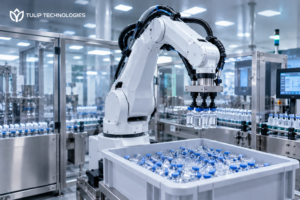
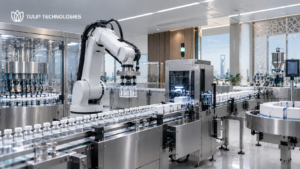
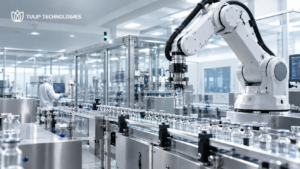
Smart factories and Industry 4.0 are transforming manufacturing by integrating automation, data, and intelligent systems. The rising demand for automation and zero-defect production exposes the limitations of manual quality inspection, which is often slow, inconsistent, and error-prone. Machine Vision Systems for Quality Inspection offer a powerful solution, enhancing accuracy, speed, and efficiency. At Tulip Technologies, this solution delivers real-time defect detection with scalable, intelligent features. Let’s talk about more machine vision systems and how they help smart factories with quote inspections.
Machine Vision Systems are advanced technologies that enable machines to “see” and interpret visual information, like human vision. These systems capture and analyze real-time images using cameras, sensors and image processing software. They are common in different industries to automate work involving visual inspection, measurement, and identification.
Machine vision improves efficiency and accuracy in production processes by eliminating human error and increasing speed. It is a very important component in modern manufacturing, where accuracy is paramount. All in all, machine vision can enable industries to be more productive and have high-quality control with minimum human intervention.
Role of Machine Vision Systems for Quality Inspection
accordance with specified standards. They identify defects like cracks, scratches, wrong shapes, or missing parts with a high level of accuracy. These systems do not get tired as they work 24/7, unlike manual inspection, which has uniform results. They also run at high speeds, and therefore, they are appropriate for high production lines.
Meanwhile, these machines assist in eliminating waste and ensuring that defective items are not supplied to the customers by detecting defects at an early stage. Besides, machine vision systems offer more detailed information and reports, which enable manufacturers to enhance processes. In general, they improve the quality of products, lower expenses, and boost customer satisfaction in industrial processes.
Key Features of Machine Vision Systems for Quality Inspection
Excellent Accuracy and Precision
The machine vision system has an extremely high accuracy when it comes to the inspection results, as it examines the images on a pixel basis. They are also able to identify the smallest defects that cannot be spotted by the human eye. This accuracy will guarantee uniformity in the quality of products and reduce possible mistakes in the inspection process.
Real-Time Processing
These systems can process images in real time; hence, inspections can be conducted in real time as they go through production. This assists in detecting defects in time, minimizing delays and avoiding defective products from proceeding down the production line. Live feedback enhances efficiency and allows prompt corrective measures.
Great Automation and Speed
Machine vision systems can automate inspection processes, eliminating the need for manual checking. They are also fast and hence suitable in large manufacturing set-ups. Automation not only raises productivity but also reduces labor costs and provides stability in the performance of inspection in the long run.
Data Collection and Analysis
These systems capture useful information during inspections, such as the type and frequency of defects. This data can be used to determine trends and enhance production. Data-based information can guide manufacturers to improve quality control measures and make better decisions to improve quality continuously.
Flexibility and Integration
The machine vision systems are easy to implement in the current production lines and can be modified to suit various inspection activities. They can be easily accommodated to different types and sizes of products. This flexibility enables them to fit in various industries and change production needs.
Implementation of Machine Vision Systems: How it Works?
Implementation of a Machine Vision System starts with the acquisition of images using cameras and lighting systems. Appropriate lighting ensures precise image capture. The images captured are then subjected to special software that examines patterns, shapes and features. The system compares the data analyzed with predefined standards to define whether the product matches quality requirements.
In case of defects, the system will issue alerts or automatically dispose of defective products in the production line. Integration with control systems provides smooth operation. In general, it is a process of capturing, processing, analyzing, and decision-making within real-time to have efficient quality inspection.
Common Application Cases of Machine Vision Systems
MVS have numerous applications in different industries. In the production industry, they check on the products whether they are defective, whether they are assembled correctly and whether they are labeled appropriately. They inspect components such as engines and body parts in the automotive industry. Meanwhile, they are used in electronics for inspecting circuit boards.
They are used by the food and beverage industry to maintain quality and proper packaging. In pharmaceuticals, they check proper labeling and identify contamination. Also, machine vision is applied in logistics in barcode sorting and barcode reading. Such applications are beneficial in enhancing efficiency, quality, and minimizing human effort in complex industrial processes.
Major Challenges and How the Product Solves Them
Common Challenges
A lot of organizations have challenges in using advanced systems, such as the high cost of using the systems, which puts a lot of pressure on the finances. The installation may be very complicated and require technical skills. The compatibility in existing systems may be an issue in integration. Above all, different lighting and environmental conditions might have a negative impact on performance and reliability in practical use.
How the Product Solves
Our product will solve these problems by simplifying the installation and configuration process and reducing the technical effort. It is cost-effective through its modular design, which minimizes the initial cost and provides scalability. The sophisticated lighting compensation guarantees uniform performance in a wide range of environments. Hence, the plug-and-play integration allows extensive compatibility with the existing systems, making the deployment process faster, easier, and more efficient.
Future Trends in Machine Vision for Smart Factories
Artificial intelligence and deep learning are the future of the Machine Vision System in smart factories. Technology allows systems to be informed by data and become more accurate with time. It can be integrated with the Internet of Things (IoT) to enable real-time communication and monitoring between machines.
Sophisticated sensors and 3D vision will help to improve the inspection of complicated products. Computing edge will allow quicker processing with reduced latency. Moreover, machine vision systems will also be cheaper and simpler to install. These trends will enable fully automated, intelligent factories that are more efficient, of better quality, and more flexible to meet the changing production requirements.
Empowering Smart Factories with Precision and Speed
In conclusion, machine vision is essential for smart factories, ensuring accuracy and zero-defect production. Solutions from Tulip Technologies deliver speed, reliability, and scalability. Adopt this technology to stay competitive and schedule a demo, request a consultation, or connect with experts today.
Frequently Asked Questions
Can machine vision systems integrate with existing factory set-ups?
Yes, modern systems are designed for seamless integration with existing production lines and automation systems.
Are machine vision systems expensive?
While the initial cost can be high, they provide long-term savings by reducing defects, waste, and labor costs.
Which industries benefit most from machine vision systems?
Industries like automotive, electronics, pharmaceuticals, food processing, and textiles benefit significantly.