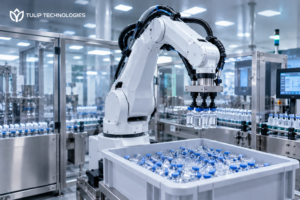
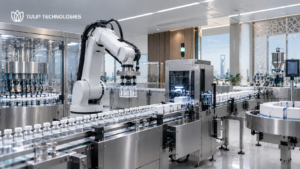
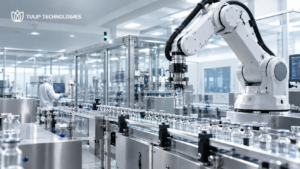
Under the Vision 2030 program, Saudi Arabia is working to grow its industries by diversifying its economy and moving to advanced manufacturing. One way factories can achieve this is through the use of robots, which help modernize their operations, reducing their dependence on oil and increasing local production. Factories that utilize smart automation to operate represent a great fit with the economic and industrial digital transformation and innovation goals.
As part of its ambitions from Saudi Vision 2030, KSA is moving quickly toward adopting robotic automation in order to develop smart factories that will increase production efficiency. Manufacturers in KSA are investing in advanced robotic solutions not only to reduce cost but also to improve quality and increase output. In conjunction with this transformation, companies such as Tulip Technologies are providing smart factory systems, real-time production monitoring, and scalable automation products that meet the unique needs of the Saudi manufacturing industry.
Higher Production with Robotic Automation
Saudi factories are going to have higher production rates and more accurate processes thanks to robotic automation. When combined with other smart machines, robots can run constantly without tiring out and creating any downtime. They easily eliminate human error, which will provide a more efficient workflow and a consistent rate of production. Advanced robotic systems also allow Saudi manufacturers to produce enough product to keep up with the demand of their respective industries while still maintaining quality. Automated factories also help to implement smart production strategies for the long-term growth of their industries.
Cost Savings & Operational Optimization
Through the use of robotics, the long-term operational costs in manufacturing companies will be reduced. Automated facilities will help to decrease all forms of waste while maintaining the best use of raw materials. Smart factories will utilize predictive monitoring to reduce energy and maintenance costs. By using robotic automation technologies, Saudi manufacturers can improve their profit margins while maintaining a high level of productivity. Automation will create a cost-effective and sustainable manufacturing environment for manufacturers in the Kingdom of Saudi Arabia.
Improved Product Quality and Precision
Robotics provides accuracy in assembly, packaging, welding, and inspecting. Automated quality control systems immediately identify defects, thus improving the consistency of the products produced. Smart production technologies assist factories in Saudi Arabia in meeting internationally accepted manufacturing standards. The majority of the manual errors have been removed, therefore, providing businesses with the ability to produce reliable and high-quality products for both domestic and international markets. It creates a stronger brand reputation and increases customer satisfaction.
Workplace Safety and Risk Reduction
An industrial robot can complete very hazardous and heavy tasks. This reduces the likelihood of injuries in the workplace. Automation provides minimal exposure to hazardous working environments. Smart factories provide safer working environments while maintaining productive processes. Saudi Arabian industries benefit from improved adherence to safety regulations and reduced costs for workers’ compensation insurance. Robotic solutions assist in providing a safer and more efficient manufacturing environment.
Data-Driven Smart Manufacturing
Robotics automation combines with IoT and real-time monitoring systems. Factories can monitor their performance and use data from past production runs to predict when maintenance will be required. These tools help manufacturers make better decisions and reduce the risk of unexpected breakdowns. Using smart techniques helps companies to optimize their processes and respond more quickly to changes in the marketplace. This provides data-driven automation, which creates innovation and competitive advantages in the industrial sector.
Cost Reduction Through Industrial Automation
Factories in KSA benefit from automation by greatly reducing their operational costs, e.g., reducing the amount of money spent on materials, thereby contributing to their competitive advantage. The use of robotic systems eliminates wasted material, decreases energy consumption, and decreases the labour cost associated with the manufacture of products. As well, smart manufacturing lines reduce the number of errors and reduce the amount of rework, therefore reducing costs. Predictive maintenance techniques reduce the number of unplanned maintenance events and the resulting repair costs. Through automation, Saudi manufacturers can increase profitability while maintaining the efficiency associated with sustainable production.
Robotic Systems for Quality Control
Robotic systems increase product quality through consistent and accurate operations. Automated Quality Control tools can quickly detect any defects in manufactured goods, thus ensuring that all manufactured goods comply with applicable quality standards. Smart factories continually monitor their manufacturing activities to ensure that all product assembly, packaging, and processing operations are performed accurately and that the resulting finished goods are free of errors and meet the requirements of their customers. By doing so, they are able to establish strong competitive advantages in local and global markets as a result of their ability to meet or exceed quality standards set forth by their customers.
Faster Manufacturing with Automation
The speed of production cycles and increases in manufacturing capacity through automated industry processes. Robot systems can operate 24 hours a day, 7 days a week, with no fatigue or downtime for operators, providing the opportunity to manufacture faster than ever before. Furthermore, with advanced manufacturing technology, the movement of materials between departments is more efficient, leading to a more streamlined process and improved coordination. Introduction of robotic automation into factories in Saudi Arabia will allow for greater access to better quality products and thus quickly expand the demand for those businesses employing it.
Reduced Labor Dependency with Automation
Robots allow for factories to become less reliant on human labor for repetitive and dangerous tasks currently performed by humans. Robots can lift heavy weights, perform precision tasks, and have improved speed, safety, and accuracy compared to humans. It allows factories to maintain production schedules in times of human labor shortages and rising labor costs. Employees will be able to focus on more high-value, skilled, and strategic functions rather than spending hundreds of hours performing the same low-value tasks. The installation of robotic automation will help to create stable production levels in Saudi Arabia and increase employee productivity.
Future-Proofing Saudi Factories with Industry 4.0
The integration of Industry 4.0 technologies in manufacturing includes robotics, artificial intelligence (AI), and smart data to drive this digital transformation in the Saudi manufacturing industry. Ongoing digital transformations prepare factory owners for innovation and long-term success. As a result, the smart factories become flexible, scalable, and globally competitive. Continuous improvement will be achieved through real-time analytics and connectivity amongst systems. Therefore, by implementing an Industry 4.0 solution, factories in Saudi Arabia can ensure sustainable industrial development and technology advancement.
Deploy Tulip Technologies Smart Factory Solutions
Discover automation at its best through Tulip Technologies, a robotics company based in Saudi Arabia that offers plug-and-play automation systems designed for, but not limited to, welding, packaging, palletizing, etc. These robots are made in Saudi Arabia and are designed to integrate seamlessly into existing production lines, giving manufacturers the ability to reduce lead times, reduce costs, and improve efficiencies. In addition to Industry 4.0 consultation services, they offer on-site support so that smart production can be simple and scalable for all production facilities in Saudi Arabia.
Ready-to-Deploy Robot Machines
Tulip Technologies provides automated robots that can be deployed quickly into factories, enabling them to improve their product quality and productivity in a short time. Each of our robot families, including the SAED, Bariq, Naqil, and Sabeg, is designed to assist with specific types of industrial production activities and can be up and running in a relatively short period of time. Our robot family consists of advanced robotic solutions for automating industrial tasks across multiple industries in Saudi Arabia. It makes it easy, fast, and reliable to achieve automated and smart factory operations.
Advanced Industrial Robot Solutions
Tulip Technologies utilizes innovative robotic technology to create highly advanced robotic automation solutions for some of the most complex industrial production activities. These types of robotics have been designed with precision, consistency, speed, and quality of manufactured products. They reduce downtime and expenses related to labor costs. Through the implementation of these types of robotic automation solutions, factories can transition to a fully automated, efficient, and smart factory production operation in KSA. Call Tulip Technologies now to automate your factory with robotic solutions.
Frequently asked questions
What industries can use Tulip Technologies’ robots?
Tulip robots are ideal for automotive, aerospace, manufacturing, logistics, laboratories, and e-commerce industries in Saudi Arabia.
Are Tulip’s robots ready to deploy?
Yes, their robot families — SAED, Bariq, Naqil, and Sabeg — are designed for quick installation and fast operational readiness.
Can robots improve production efficiency?
Absolutely. Automation reduces downtime, speeds up repetitive tasks, and ensures consistent quality across all production lines.
Do these robots handle material and assembly tasks?
Yes, Tulip offers material handling, assembly, end-of-line, and order fulfillment robots for smooth operations and precise workflows.
Are these robots suitable for lab automation?
Yes, Tulip provides lab automation robots for sample preparation, testing, and analysis, ensuring faster and more accurate results. Advanced solutions include;
- robotic welding
- robotic drilling and riveting
- robotic machine tending
- robotic paint shop automation
- robotic material handling
- robotic assembly
- robotic laboratory automation
- robotic end-of-line processing,
- robotic order fulfillment systems